Reptiles are among the fossils that have been studied the longest. Since they were first described in 1699, they have been the subject of intensive research (Lhuyd 1699; Wallstedt et al. 2024). And yet, research continues to uncover surprises to this day. It becomes particularly exciting when not only bones are preserved, but also soft tissues: skin, pigments, stomach contents, and entire body outlines.
Many of these milestones date back to the Posidonia Shale of Holzmaden. This article traces seven key moments spanning more than 250 years of research.
1699: First publication on ichthyosaurs
The starting point is provided by the Welsh naturalist Edward Lhuyd. In his work *Lithophylacii Britannici Ichnographia*, published in 1699, he depicts fossil remains that are now classified as ichthyosaurs (Lhuyd 1699). At the time, it was not yet known that these were marine reptiles. Nevertheless, this illustration is considered the first documented study of a reptile. Research on the subject has continued unabated ever since.
1836: First evidence of soft tissues
About 140 years later, the next breakthrough occurred. In 1836, William Buckland described what he believed to be skin remnants on a specimen from the Lower Jurassic of Lyme Regis in southern England—the first documented preservation of soft tissues in an ichthyosaur (Buckland 1836). After that, such finds became more frequent, particularly from the Jurassic fossil beds in Germany and Great Britain. Lyme Regis and the Swabian Posidonia Shale became the most important fossil sites.
1892: The Breakthrough in Holzmaden
Perhaps the most significant moment in Swabian paleontology took place in Holzmaden. In 1892, Bernhard Hauff (1866–1950) succeeded, through painstaking preparation, in revealing the complete body outline of an ichthyosaur approximately 1.2 meters long (Berckhemer 1936; Hegele 2007). Until then, the preservation of skin in this manner had been considered unthinkable. The discovery caused a great stir and, at first, incredulous amazement.
Hauff’s father had originally come to Holzmaden to extract oil from shale. That proved unprofitable. Bernhard Hauff, on the other hand, recognized the value of the fossils and developed new preparation techniques. Starting in 1906, he gave up commercial shale mining and devoted himself entirely to fossil preparation. His specimens found their way into museums and collections all over the world.
In 1921, Hauff published his scientific paper on the Holzmaden sites (Hauff 1921). The University of Tübingen awarded him an honorary doctorate for this work. The art of fossil preparation has hardly changed since 1892: Only a subtle difference in color between brown bone and gray slate guides the preparator in exposing preserved skin. The use of a graver and a fine-beam light source, which is popular today, is entirely unsuitable for this purpose.
1968: A Look Inside the Stomach of the Reptile Ichthyosaurs
Soft tissues reveal not only what an animal looked like, but also what it ate. A classic example of this was provided by John E. Pollard’s publication. He described the stomach contents of a small ichthyosaur from the Lower Lias of Lyme Regis (Pollard 1968). The stomach contents consisted almost entirely of tiny hooks from cephalopods, such as squid.
Pollard estimated that the mass was equivalent to the tentacles of approximately 760 to 2,430 squids. He compared the diet and digestive system of ichthyosaurs to those of the sperm whale, which also hunts cephalopods. Such stomach contents had already been documented in the 19th century, including by William Buckland in 1836.
2018: Stenopterygius with a layer of fat
Almost exactly 50 years later, a team led by Johan Lindgren made headlines. The researchers identified a fossilized layer of blubber on a Stenopterygius specimen from the Posidonia Shale (Lindgren et al. 2018). Volker Thiel was also involved in the research at the University of Göttingen. Such fat deposits are typical of modern marine mammals. They provide insulation against the cold, aid in buoyancy, and serve as energy reserves.
This evidence supports the theory that ichthyosaurs were warm-blooded. In addition, the team found clues about their coloration: The skin was apparently dark on top and light on the underside—a reverse shading pattern seen in many modern marine animals. This provides camouflage, protects against UV light, and aids in thermoregulation. The pigment melanin was even detectable. The similarity between ichthyosaurs and modern toothed whales is thus not merely superficial.
2024: Microscope and Molecule
The 2018 discovery was not an isolated case, but part of a broader trend. Modern methods—electron microscopy, mass spectrometry, and chemical analyses—now allow us to examine individual cells and molecules. For example, all three layers of skin (epidermis, dermis, subcutis) as well as pigment cells (melanophores) and pigment granules (melanosomes) have been identified in ichthyosaurs. Remains of internal organs such as the liver and digestive tract have also been documented (Eriksson et al. 2022).
A 2024 study demonstrates the potential of these methods. Using a young reptile specimen from the Toarcian “Schistes Carton” in Luxembourg—which formed largely at the same time as the Posidonia Shale—the team reconstructed the skin’s stratification, including its pigment cells (Wallstedt et al. 2024). Growth lines in the ribs also indicated a minimum age of three years. The authors attribute the exceptional preservation to rapid phosphatization under low-oxygen conditions. Notably, this specimen also comes from an amateur collector who recovered it in the early 1990s.
2025: Fins with cartilaginous skin
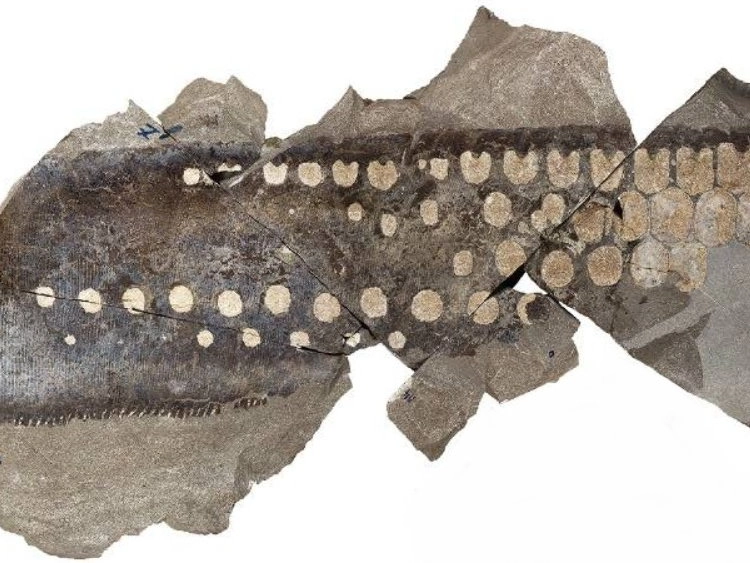
The most recent highlight came in 2025 with a paper published in *Nature*. An international team led by Johan Lindgren and ichthyosaur expert Dean Lomax examined a forelimb approximately one meter long from Temnodontosaurus trigonodon (Lindgren, Lomax, Sachs et al. 2025). This reptile grew to over ten meters in length and stood at the top of the food chain some 183 million years ago.
The fossil was discovered in 2014 by amateur collector Georg Göltz in a quarry near Dotternhausen. The result of the collaboration between the collector and scientists is remarkable: The fin’s trailing edge features a serrated structure made of reinforced cartilage tissue, for which the team coined a new term—“chondroderm.” Such structures are unknown in any other animal, living or extinct.
The team reconstructed this function using 3D simulations, among other methods: The jagged edge likely dampened noise while swimming. This allowed Temnodontosaurus to stalk its prey almost silently—much like how modern owls hunt silently thanks to their flight feathers. Combined with the animal’s enormous eyes, this paints a picture of a silent hunter in the depths. Today, the specimen is on public display at the private Paleontological Museum in Nierstein near Mainz. An interesting side note: The first complete ichthyosaur skeleton, which Mary Anning discovered over 200 years ago, was also a Temnodontosaurus.
Conclusions After 250 Years of Ichthyosaur Research
Research on reptile ichthyosaurs spans more than 250 years. And yet, sensational findings continue to come to light. This is due, in part, to new analytical methods that now make it possible to identify even pigments and molecules.
On the other hand, it comes down to the finds themselves. Some significant fossils do not become available to scientists until years after their discovery. The Temnodontosaurus from Dotternhausen reached researchers about a decade after its recovery; the Luxembourg reptile lay untouched even longer before it was examined. In Baden-Württemberg, there is the added complication that finds must be reported and may legally become the property of the state—a situation in which collectors and scientists do not always find it easy to collaborate. This makes the most recent examples all the more valuable. They demonstrate a win-win situation: when amateur paleontologists and scientists collaborate, both sides benefit—and with them, science as a whole.
Sources
- Berckhemer, F. (1936): Bernhard Hauff on His 70th Birthday. Annual Reports of the Society for Local Natural History in Württemberg 92: XLII–XLIII.
- Buckland, W. (1836): Geology and Mineralogy Considered with Reference to Natural Theology (Bridgewater Treatise). London.
- Eriksson, M. E., De La Garza, R., Horn, E., & Lindgren, J. (2022): A review of ichthyosaur (Reptilia, Ichthyopterygia) soft tissues with implications for life reconstructions. Earth-Science Reviews 226: 103965.
- Hauff, B. (1921): A Study of the Fossil Sites at Holzmaden in the Posidonia Shale of the Upper Lias of Württemberg. *Palaeontographica* 64. Stuttgart.
- Hegele, A. (2007): “The countless army of fossils lay scattered about, just waiting to be collected.” On the “Handling” of Fossils in the Context of the Boll/Göppingen Geopark Information Center. Proceedings of the Federal Geological Survey 60: 77–84.
- Lhuyd, E. (1699): *Ichnographia of the Lithophylacii Britannici*. Gleditsch & Weidmann, London.
- Lindgren, J., Sjövall, P., Thiel, V., et al. (2018): Soft-tissue evidence for homeothermy and cryptic coloration in a Jurassic ichthyosaur. Nature 564: 359–365.
- Lindgren, J., Lomax, D. R., Sachs, S., et al. (2025): Adaptations for stealth in the wing-like flippers of a large ichthyosaur. Nature. DOI: 10.1038/s41586-025-09271-w.
- Pollard, J. E. (1968): The gastric contents of an ichthyosaur from the Lower Lias of Lyme Regis, Dorset. *Palaeontology* 11(3): 376–388.
- Bonnevier Wallstedt, I., Sjövall, P., Thuy, B., De La Garza, R. G., Eriksson, M. E., & Lindgren, J. (2024): Skin Anatomy, Bone Histology, and Taphonomy of a Toarcian (Lower Jurassic) Ichthyosaur (Reptilia: Ichthyopterygia) from Luxembourg, with Implications for Paleobiology. Diversity 16(8): 492.
Image credit: Lindgren, J., Lomax, D. R., Sachs, S., et al. (2025): Adaptations for stealth in the wing-like flippers of a large ichthyosaur. Nature, via PMC / Nature. Licensed under CC BY 4.0