Feathered dinosaurs from Liaoning, marine reptiles from Guizhou and Yunnan, and birds from China’s Cretaceous period: Fossils of extraordinary scientific significance have been appearing for years on major auction houses and sales platforms. Most are offered for sale from Taiwan or Hong Kong with a “certificate of authenticity.” Almost always, the trail leads back to mainland China—and under current law, these sales are mostly illegal.
This article explains why Chinese fossils are protected and what laws apply.
The Fascination of Fossils from China
China is home to some of the world’s most significant fossil sites. The Jehol Biota in Liaoning (Lower Cretaceous) is the source of the famous feathered dinosaurs, primitive birds such as Confuciusornis, and exquisitely preserved skeletons with skin and feather impressions. Complete marine reptiles—ichthyosaurs such as Mixosaurus, thalattosaurs such as Anshunsaurus, nothosaurs, and Keichousaurus—have been found in the Middle and Upper Triassic strata of Guizhou and Yunnan.
The Legal Situation in China: Comprehensive Protection of Fossils
The protection was structured in three stages:
- 1982 – Cultural Heritage Act. Article 2 of the “Law of the People’s Republic of China on the Protection of Cultural Property” (November 19, 1982) expressly places vertebrate fossils and early human fossils of scientific value under the same state protection as cultural property. Since then, the export of protected vertebrate fossils has been subject to authorization or prohibited.
- 2002 – Excavation Rules. The Ministry of Land and Resources issued uniform administrative regulations on fossil excavation for the first time and consolidated jurisdiction under a single agency—a step toward addressing the previously patchy oversight.
- 2011 – The Comprehensive Fossil Protection Ordinance. Under State Council Decree No. 580, the “Regulations on the Protection of Paleontological Fossils” (adopted on August 25, 2010, effective as of January 1, 2011; amended by Decree No. 709 on March 2, 2019), fossils were granted their own protection status for the first time—separate from cultural property law. For the first time, invertebrates, plants, and trace fossils are also protected at the national level.
Fossils subject to special protection may be exported only in strictly limited exceptional cases and with official authorization; their sale, exchange, or transfer to foreign nationals or foreign institutions is prohibited. Thus—contrary to the widespread perception of a law “from around 2005”—it is not a single year that is decisive, but rather this phased ban, which has been in effect nationwide since at least 2011. Serious violations of cultural property and smuggling laws in China can be punished with long prison terms, or in severe cases, life imprisonment.
The catalyst for export restrictions: Senckenberg Psittacosaurus
A prominent example from Germany illustrates just how controversial this topic is. The Senckenberg Natural History Museum in Frankfurt houses an exceptionally well-preserved Psittacosaurus (collection number SMF R 4970) from the Jehol Biota in Liaoning. The specimen features fossilized skin, bristle-like structures on its tail, and even stomach contents.
The artifact left China in the 1990s under legally questionable circumstances, amid a wave of fossil smuggling from Liaoning. The museum acquired it around 2001 from a well-known German fossil dealer for approximately $200,000; a controversial debate erupted over its legal ownership. Scientifically, the find is now considered a treasure—described as the only known cloaca of a non-avian dinosaur to date (Vinther et al. 2021) and later reexamined using laser-induced fluorescence (Bell et al. 2022).”
Such cases—including the 1999 Archaeoraptor forgery scandal—increased pressure to tighten Chinese law. The comprehensive regulation of 2011 is also a response to this.
What international and German law have to say on the matter
Protection does not end at China’s border. A multi-tiered regulatory framework applies to imports into Europe:
- 1970 UNESCO Convention. The Convention on the Means of Prohibiting and Preventing the Illicit Import, Export, and Transfer of Ownership of Cultural Property requires States Parties to cooperate. China has been a State Party since 1989, the Netherlands since 2009, and Germany has implemented it domestically.
- EU Regulation 2019/880. It regulates the import of cultural goods into the EU, which also includes specimens of paleontological interest. The general import ban on goods that were unlawfully exported from their country of origin has been in effect since December 28, 2020—regardless of age or value. As of June 28, 2025, there is an additional requirement to submit, depending on the category, either an import license or an import declaration via the central EU system (ICG).
- German Cultural Property Protection Act (KGSG), 2016. Section 28 of the KGSG prohibits the import of cultural property that a State Party (e.g., China) classifies as national cultural property and that was removed from the country in violation of that State’s export laws. The cut-off date of April 26, 2007, is relevant in practice for transfers from UNESCO contracting states. Anyone who knowingly imports such cultural property is liable to prosecution under § 83 of the KGSG—with a prison sentence of up to five years. The law applies to imports made since its entry into force on August 6, 2016, and does not have retroactive effect.
For a Chinese vertebrate fossil, this generally means: If it was exported from China without a permit after 2007 and imported into Germany after 2016, the import is prohibited and punishable by law if the importer is aware of this—regardless of which third country it passed through.
The Detour Through Taiwan and Hong Kong
This is exactly where the common pattern begins. The fossils are transported from the mainland to Hong Kong or Taiwan and “re-exported” from there to the rest of the world as supposedly legal goods. To justify this, the argument goes, for example, that such goods can be legally imported from Taiwan, that there is unrestricted trade with the People’s Republic, and that there are no restrictions on fossils in Taiwan, which is why they may be exported.
This argument misses the point. The UNESCO Convention, the EU Regulation, and the KGSG all refer to the country of origin—that is, the country where the fossil was formed and discovered. That is China. Transit through a third country does not remedy an unlawful export from China. The stopover obscures the origin but does not change the legal situation.
The Catawiki platform as a central marketplace for Chinese fossils
The trade in Chinese fossils has been strictly enforced by U.S. Customs and Border Protection (ICE) for years. Chinese vertebrate fossils are not found at the major fossil shows in Tucson or Denver. Regulations in the United Kingdom are similarly restrictive.
France, too, has recently tightened its stance for 2025. At Mineral&Gem—the world’s second-largest show after Tucson—French customs patrols were announced for the first time. As if by magic, within a few hours, the otherwise popular fossils such as Anchiornis and Mixosaurus, as well as the relatively common Keichousaurus, had vanished from the tables.
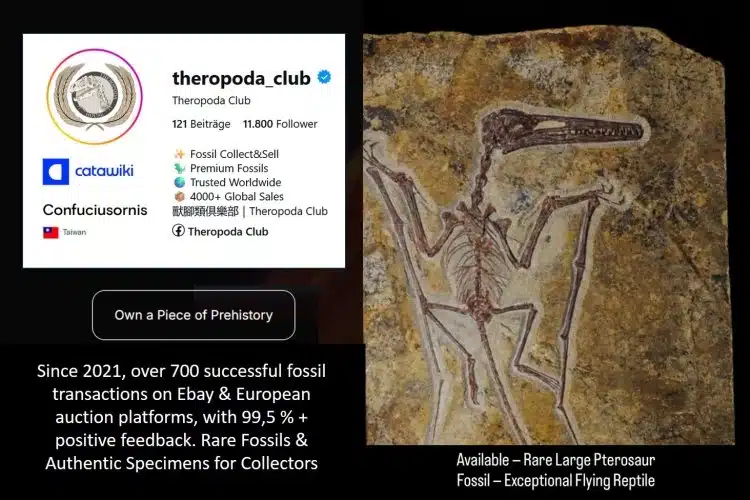
Catawiki, based in the Netherlands, has established itself over the years as a central hub for Chinese fossils and has recently further expanded this market position. Feathered predatory dinosaurs are sold there by the global market leader Theropoda Club .
Catawiki is trying to protect itself with its disclaimer:
“The seller has been informed by Catawiki of the documentation requirements and guarantees the following: – The item was acquired legally. – The seller has the right to sell and/or export the item (if applicable). – The seller will provide the required provenance information and obtain the necessary documents, permits, and/or licenses (where applicable and as required by local laws). – The seller will inform the buyer of any delays in obtaining permits or licenses. By submitting a bid, you acknowledge that, depending on your country of residence, import documents may be required and that obtaining permits or licenses may result in delays in the delivery of your item.”
How to Tell If Someone’s Background Is Made Up
However, this cleverness does not hide the fact that sellers there are doing everything they can to conceal the fact that the goods are exported from China.
- Backdated provenance. The “statement of provenance” claims that the item was acquired before the protection laws went into effect—for example, “acquired in 1980, in the collection since 1989.” Such rounded-off pre-1982 dates appear in virtually identical form in a great many lots.
- Conflicting origins. On Catawiki, the country of origin is often listed as “Asia” rather than “VRC.” The certificate lists “Yunnan, China” as the place of discovery, while the accompanying customs declaration lists “Taiwan” as the country of origin. Both cannot be correct at the same time.
- Incorrectly declared customs documents. Instead of the correct customs tariff number for fossils (Heading 9705 or HS Code 97052200: “Specimens of extinct or endangered species and parts thereof … of paleontological value”), an incorrect number and a minimal value are listed—such as “sculpture, 50 euros, gift”—to conceal the contents and value.
- A specimen that does not match the dating. If a piece that was supposedly found before 1982 is prepared using fine-blasting techniques, this is a contradiction: this preparation method did not emerge until the late 1980s. Often, “sandblasting” is even cited as a mark of quality in the item description.
The collector decides
Anyone who buys or sells fossils bears responsibility—both legally and scientifically. In practice, the following has proven effective:
- Insist on a genuine, verifiable export license from the country of origin, not on a “certificate” issued by the seller.
- When in doubt, steer clear of Chinese vertebrate fossils—legal specimens are the absolute exception.
Conclusion
Admittedly, the temptation to own a pterosaur or a feathered predatory dinosaur is great. Who can actually afford a “flyer” from Solnhofen? And yes, the quality of the preparation of Chinese fossils is now second to none. But the joy is somewhat dampened when you realize that you’re only the legal owner—the People’s Republic of China remains the rightful owner.
One consolation: When it comes to restoration and tampering, Chinese fossils continue to hold a “leading position.” All the feather impressions I’m aware of have turned out to be colored handicrafts. Epoxy resins—which are no longer detectable under UV light—have become commonplace. Reconstructions made from bone meal are popular. And the latest development: AI-generated X-ray images tailored to the fossil are offered as proof of authenticity. It remains an intriguing development.
Sources
- Regulations on the Protection of Paleontological Fossils – State Council Decree No. 580 (adopted August 25, 2010; effective January 1, 2011; amended by Decree No. 709, March 2, 2019). English version: en.moj.gov.cn.
- Law of the People’s Republic of China on the Protection of Cultural Property (1982, amended several times), Article 2.
- Liston, J. J. & You, H.-L. (2015): Chinese Fossil Protection Law and the Illegal Export of Vertebrate Fossils from China. Journal of Vertebrate Paleontology 35(2): e904791.
- Liston, J. (2015): Fossil Protection Legislation—Chinese Issues, Global Problems. Biological Journal of the Linnean Society 113: 694 ff.
- Ding, Y. & Xiong, L. (2002): China Issues Rules on Fossil Excavation. Science 297: 1981 (regarding the excavation rules issued by the Ministry of Land and Resources in 2002).
- Dalton, R. (2001): “Wandering Chinese fossil turns up at museum.” *Nature* 414: 571.
- Mayr, G., Peters, D. S., Plodowski, G., & Vogel, O. (2002): Bristle-like integumentary structures on the tail of the horned dinosaur Psittacosaurus. Naturwissenschaften 89 (First description SMF R 4970).
- Vinther, J., Nicholls, R., & Kelly, D. A. (2021): A cloacal opening in a non-avian dinosaur. – Current Biology 31(4): R182–R183. DOI: 10.1016/j.cub.2020.12.039.
- Bell, P. R., Hendrickx, C., Pittman, M., Kaye, T. G., & Mayr, G. (2022): The exquisitely preserved integument of Psittacosaurus and the scaly skin of ceratopsian dinosaurs. – Communications Biology 5: 809. DOI: 10.1038/s42003-022-03749-3.
- The 1970 UNESCO Convention on the Means of Prohibiting and Preventing the Illicit Import, Export, and Transfer of Ownership of Cultural Property.
- Regulation (EU) 2019/880 on the movement and import of cultural goods, and Implementing Regulation (EU) 2021/1079 (general ban effective as of December 28, 2020; authorization/importer’s declaration effective June 28, 2025). eur-lex.europa.eu.
- Cultural Property Protection Act (KGSG) of July 31, 2016, in effect since August 6, 2016, Sections 28, 30, 32, 83. gesetze-im-internet.de; kulturgutschutz-deutschland.de.
- U.S. Immigration and Customs Enforcement / HSI (2015): Colorado Dinosaur Fossil Smuggler Sentenced in Wyoming (Magovern Case). ice.gov.
- Harmonized System / Combined Nomenclature, heading 9705, subheading 9705.22 (specimens of paleontological interest; HS version 2022).