Thirty years ago, in December 1995, the Messel Pit near Darmstadt became Germany’s first natural site to be inscribed on the UNESCO World Heritage List. This makes 2025 a milestone year in three respects: 30 years as a World Natural Heritage Site, 50 years of systematic excavations by Senckenberg, and 150 years since the first fossil discovery. To mark the occasion, the Museum at the World Heritage Site is presenting the special exhibition “FLOWER-POWER! Insects in a Blossom Frenzy.”
For me, this anniversary brings back memories—of an excavation, of my first attempts at specimen preparation, and of a time when science and overexploitation went hand in hand in Messel.
Why Fossils from Messel Are So Important for Evolution
The fossils from Messel date back to the Eocene, about 47 million years ago. This was the period following the extinction of the dinosaurs, when mammals colonized the habitats that had been left vacant and rapidly evolved into many new forms. Messel illustrates this moment like no other place.
The reason is the exceptional state of preservation. The fine oil shale has preserved not only skeletons, but also the outlines of skin and fur, feathers, stomach contents, and even unborn fetuses. So you can see not only how an animal was built, but also what it ate and how it lived. The small prehistoric horses are particularly famous, including pregnant mares carrying their foals.
This makes Messel far more than just a beautiful fossil site. It is an almost complete window into an early mammalian ecosystem—and one of the most important sources for understanding the origins of our own clade.
Almost a landfill
Oil shale mining in Messel ended in 1971. After that, the large hole was supposed to be turned into a landfill for the Rhine-Main region. The fact that this never happened is primarily thanks to a tenacious citizens’ initiative from Messel.
However, opposition also came from the scientific community. At the University of Tübingen, then one of the leading centers of German paleontology, Prof. Frank Westphal advocated for the preservation of the quarry. He was a vertebrate paleontologist and curator of the important Tübingen collection, and he brought the institute’s influence to bear in the discussion.
The 1989 Archaeological Excavation
In 1989, as a geology student at the University of Tübingen, I took part in one of the university’s excavation campaigns. It was led by Eberhard “Dino” Frey, who was working on his doctoral dissertation in Tübingen at the time on the structural morphology and biomechanics of crocodiles.
The density of fossils was impressive. Something turned up almost every time we split the damp oil shale. The primitive mudfish Amia was found in vast quantities. The highlight was a crocodile, Diplocynodon darwini, which was spent half a year being prepared by a taxidermist after its recovery. The following year, I worked as a research assistant at the institute and prepared fish. That was my first training in taxidermy.
A nice bit of coincidence: The very first specimen found in the pit, recovered about 150 years ago, was also a Darwin’s double-toothed crocodile.
The Other Side: Nighttime Grave Robbers
As exciting as the work was, it had a downside: uncontrolled, commercial overexploitation. The mine was a vast area that was virtually impossible to secure.
We dug during the day and documented every find. At night, however, we would sometimes see a faint light in the distance, deep down in the pit—presumably coming from a makeshift tent. Illegal collectors were at work there, excavating fossils for the black market.
That’s why we couldn’t just leave the crocodile mentioned earlier lying there. It had to be retrieved that very same day. If it had been left out overnight, it probably would have been looted by morning.
How do you prevent a fossil from disintegrating?
The fact that Messel fossils can be seen in collections and museums today is thanks to an invention that originated in the private collecting community. Oil shale consists largely of water. When it dries out in the air, the rock shrinks, cracks, and crumbles—and the fossil along with it.
In the late 1970s and early 1980s, collectors developed a transfer mounting technique using synthetic resin. In simple terms, the process works as follows:
- The fossil is first exposed on one side of the slab, which is still damp.
- This surface is coated with liquid synthetic resin.
- After curing, the slab is turned over and the oil shale is removed from the back.
- The fossil is now securely embedded in the plastic plate.
The method was an important step. It can be applied to other sites—anywhere where the rock is highly prone to drying out. Just how closely this technique is associated with Messel became evident decades later in court: In the dispute over the “Ida” fossil, there was serious debate about the age of the synthetic resin method in order to narrow down the date of discovery (see below).
Its counterpart in the east: the Geisel Valley
A site very similar to Messel is located in Saxony-Anhalt: the Geiseltal valley, west of Merseburg. Here, too, the fossils date from the Middle Eocene—that is, from the same period, about 47 million years ago. Instead of being embedded in oil shale, however, they were found in lignite here.
Between 1933 and 1993, tens of thousands of fossils representing more than a hundred species were unearthed at the open-pit mine—including ancient horses, early tapirs, and terrestrial crocodiles. Experts consider the Geisel Valley to be just as significant as Messel. Because the collection was virtually inaccessible during the GDR era, it was long forgotten. Both sites share a common problem: their rock is unstable, and the fossils can only be permanently preserved using special embedding and transfer techniques.
Record Prices: What a Messel Fossil Is Worth
A Messel crocodile, like the one we recovered in 1989, is now a sought-after collector’s item. In December 2023, the Koller auction house in Zurich auctioned off a fossilized crocodile from Messel—measuring approximately 55 by 135 centimeters—from a private German collection. Hammer price: 200,000 Swiss francs, including the buyer’s premium. Such prices explain why Messel fossils are so coveted—and why provenance and legality play such a major role. No case illustrates this more clearly than “Ida.”
The Ida Case: A Global Star with a Question Mark
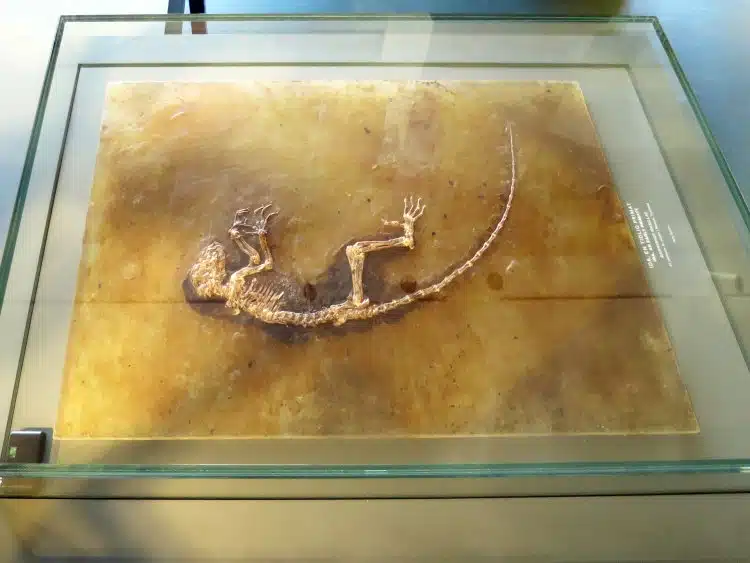
No Messel fossil is more famous than “Ida.” On May 19, 2009, the approximately 47-million-year-old primate skeleton (Darwinius masillae) was unveiled in New York—amid great media fanfare; even the city’s mayor was in attendance. Ida was marketed as the “missing link” between humans and apes. The specimen was sold by Bad Homburg-based fossil dealer Thomas Perner—for years the leading dealer in Messel fossils—to the Natural History Museum in Oslo. Ida was named after the daughter of Oslo-based researcher Jørn Hurum.
However, her scientific fame did not stand up to scrutiny. Later studies classified Ida as an adapiform—a group that is more closely related to modern lemurs than to the lineage leading to apes and humans.
Even more revealing is the dispute over ownership. A former landowner of the mine demanded a share of the proceeds from the sale—as a co-owner of a “treasure” under Section 984 of the German Civil Code (BGB). He lost his case in court because he could not prove exactly when and where Ida was found. Witnesses cited discovery years ranging from 1973 to 1983. Without proof that the discovery occurred during his period of ownership, he had no claim. The Frankfurt Higher Regional Court finally dismissed the lawsuit in 2014 (Case No. 12 U 42/13). Incidentally, the court clarified that fossils are not subject to mining law but rather to the law governing the discovery of treasure.
What is legal today?
Anyone wishing to purchase a Messel fossil today must operate within a strictly regulated framework. In Hesse, such finds are subject to the Hessian Monument Protection Act.
- The treasure law applies: Newly discovered artifacts automatically become the property of the State of Hesse.
- Private excavations are prohibited. The right to conduct excavations is reserved for authorized institutions such as the Senckenberg Society.
- For the market, the key date is: From the end of mining in 1971 until the site was designated a protected area in 1991, access was regulated but not strictly prohibited. The comprehensive ban came with the UNESCO designation in 1995.
- Artifacts discovered legally or with tacit approval prior to 1991 continue to be considered private property and may be traded.
A complete chain of provenance is essential. Many fossils from Messel are also subject to the Cultural Property Protection Act and may not be exported without a permit. They are rare on the open market, and a purchase should only be made with a certificate that includes proof of provenance.
The Local Museum
Senckenberg is the main attraction in Messel—both in Frankfurt and at the visitor center at the excavation site. But there’s also a quieter, very personal spot: the Messel Fossil and Local History Museum right in the center of the village. It’s sponsored by the municipality and run on a volunteer basis by the Messel Museum Association (Museumsverein Messel e.V.); admission is free.
The museum brings together two stories that are closely linked. It displays fossils dating back some 48 million years—alongside the history of the town: the century-old oil shale industry, which at times accounted for a large portion of Germany’s petroleum production, and the successful resistance of the people of Messel against the landfill.
This is more than just local color. A World Heritage site also thrives on being rooted in the local community—on a community recognizing its site as its own heritage, preserving it, and passing it on to future generations.
Conclusion
Thirty years after being inscribed on the World Heritage List, Messel is doing well. The site is a scientific success, offering a unique window into the early evolution of mammals.
To me, however, their fossils also tell a turbulent story: of damp slate and its preparation, of nighttime grave robbers, of six-figure bids, and of a “dethroned” global star named Ida. The common thread: Anyone who owns or wants to acquire a specimen from Messel should pay close attention to one thing above all else—clean, complete documentation of its provenance.
Incidentally, you can see just how valuable a local museum like this is by looking at places where one is missing—such as at the world-famous slate fossils in Bundenbach in the Hunsrück. But that’s another story, which I’ll cover elsewhere.
Sources
- Messel Pit World Heritage Site: grube-messel.de
- Messel Fossil and Local History Museum (Museumsverein Messel e.V.): messelmuseum.de
- Senckenberg, Museum at the World Heritage Site: Special Exhibition “FLOWER-POWER! Insects in a Blossom Frenzy” (April 4, 2025 – February 1, 2026), Press Release
- Hesse State Government (hessen.de) and the German National Commission for UNESCO: 30 Years of the Messel Pit World Natural Heritage Site, Press Release
- Martin Luther University Halle-Wittenberg: Geiseltal (March 24, 2020), Press Release
- Koller Auctions, Zurich: “Fossil Crocodile” from Messel, sold for CHF 200,000 (auction “Out of This World,” December 2023)
- Frankfurt Higher Regional Court, Judgment of June 27, 2014, Case No. 12 U 42/13 (Acquisition of Ownership of“Darwinius masillae” / “Ida”fossils)
Image credit: Reinhard Dietrich, CC BY-SA 4.0, via Wikimedia Commons