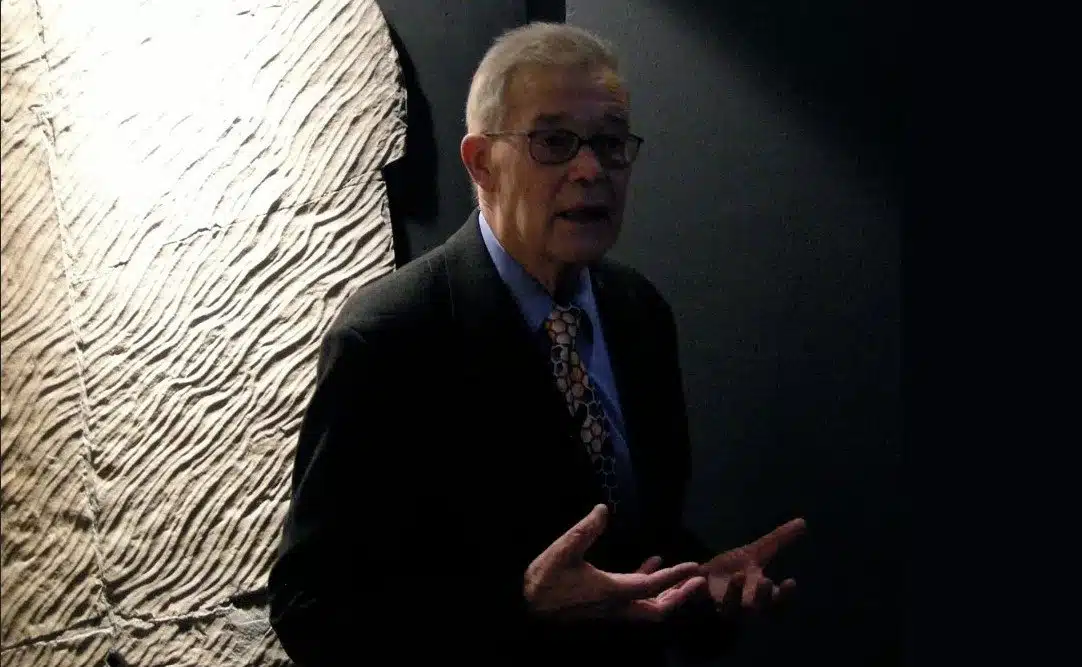
Our current understanding of paleontology—particularly of the classic fossil sites of the Holzmaden Posidonia Shale and the Hunsrück Shale—is closely linked to Adolf “Dolf” Seilacher. He revolutionized the geosciences—entirely without computers, relying solely on the power of his trained eye. The 100th anniversary of his birth (February 24, 1925 – April 26, 2014) provides an opportunity to reflect on his legacy.
From Shark-Tooth Collector to the Doyen of Paleobiology
Even as a schoolboy, Seilacher was fascinated by fossils. Encouraged by the collector and amateur paleontologist Hugo Rühle von Lilienstern, he attended the annual conference of the Paleontological Society for the first time in 1939—at just 14 years old. At age 18, in 1943, he published his first scientific paper: on the teeth of fossil freshwater sharks from the Keuper Formation in his native Swabia, around Gaildorf.
After serving in the Navy during the war, he began studying geology and paleontology in Tübingen in 1945. He found little appeal in the lectures of the famous but conservative vertebrate paleontologist Friedrich von Huene. So he switched to studying under the invertebrate paleontologist Otto Heinrich Schindewolf. In 1951, he earned his doctorate under Schindewolf with a dissertation titled “On the Classification and Interpretation of Fossil Trace Fossils”—marking the birth of modern paleoichnology, the study of trace fossils.
“Dolfifying”: How a Man from Seilach Brought Dead Stone Back to Life
Seilacher had a gift that became a technical term: “to be dolfed,” or to be “dolfized.” Anyone who spoke with him was captivated by his imagination. Where others saw only a lifeless rock, Seilacher perceived the dynamic behavior of organisms millions of years old.
As a professor in Göttingen (1961–1964), as Schindewolf’s successor in Tübingen (1964–1990), and, beginning in 1987, for over two decades at Yale University, he did away with entrenched academic doctrines:
- The Ediacaran biota (“Vendobionts”): Seilacher offered a completely new interpretation of these enigmatic, oldest multicellular organisms on Earth. Instead of seeing them as ancestors of today’s jellyfish, he viewed them as an evolutionary dead-end experiment: mouthless and gutless, chamber-like, quilted mattress-like structures (pneumatic structures) that fed on microbial mats.
- Trophic escalation: He described the boundary between the Precambrian and the Cambrian as a biohistorical revolution—the transition from shallow organic mats to vertical disturbance of the sediment (bioturbation), which created entirely new ecosystems.
- Structural Morphology & Morphodynamics: Working closely with Stuttgart-based lightweight-structure architect Frei Otto (Collaborative Research Center 230, “Natural Structures”), Seilacher demonstrated that biological forms are more than just genetics. They arise from the interplay of function, structural limitations (statics), and phylogenetic heritage.
His mode of transportation was also part of this unconventional image: As I recall, Seilacher rode his old Vespa to the university—he had never gotten a driver’s license. He cared little for practical conventions.
Sovereignty in the Face of Forgery: The Belemnite Affair
Seilacher’s intuitive mind made him a genius, but sometimes also left him vulnerable. There is a legendary anecdote involving his students Joachim Reitner and Wolfgang Riegraf from the late 1970s. Collectors had sold Seilacher supposedly “perfect,” complete belemnite soft-tissue fossils—complete with tentacles and ink sacs. Enthusiastically, he published the discovery and hung the magnificent specimen in the stairwell of the Tübingen Institute.
When the two of them mustered the courage to take the exhibit down from the wall after an institute celebration, they exposed it as a glued-together forgery—two organisms assembled into a “animal,” a composite. Seilacher reacted with unparalleled composure. Instead of sweeping the discovery under the rug, he urged them: “Take the institute bus and examine the pieces in the other museums!” To the bitter realization of the curators there, all of them originated from the same forger’s workshop. For Seilacher, this was proof that his teaching was working: his students had learned to look at things critically.
Drawing as Research
Seilacher did not need any expensive infrastructure. His most important tool was thecamera lucida, which he had inherited from Friedrich von Huene. True to the old adage, “What you haven’t drawn, you haven’t seen,” he captured every observation in a drawing—amid the cigar smoke in his study, out in the field, or, if necessary, on a loose stone slab.
But it was about more than just tracing. Seilacher mastered, like few others, the art of capturing complex concepts in diagrams—using ink and adhesive film in various dot grids and patterns. Many of his publications bear witness to this.
I experienced firsthand just how quick and accurate he was. In the second semester, I brought him a find: a round stone with a white, meandering pattern from the chalk cliffs near Dover. I had already shown it to his fellow professors, but their answers didn’t satisfy me. The structural geologist recognized microtectonic folds, while the mineralogist identified it as “snake gypsum.” Seilacher’s whole face lit up with a smile—and before I knew it, he was already sitting at his drafting table.
That’s where the explanation emerged: The supposed stone was a flint nodule containing a fossilized siliceous sponge (Coeloptychium) at its core; its radial folds appeared in the cross-section as the mysterious “meandering band.” Shortly thereafter, Seilacher called in the institute’s photographer. It went without saying to him that the short article should be published under my name; he took care of the rest himself with the *Paleontological Journal *. The title he chose says it all about him: “A Fossil Cherry.” Conventions meant little to him; he preferred to swim against the current—always with a twinkle in his eye.
The “Nobel Prize of the Geosciences” and Fossil Art
In 1992, Seilacher received the highest honor in the earth sciences: the Crafoord Prize from the Royal Swedish Academy of Sciences, presented by the King of Sweden. He used the prize money—650,000 marks—to fund research trips around the world and his traveling exhibition “Fossil Art”; he donated the remainder to the newly established Edith and Adolf Seilacher Foundation, which to this day invites international paleontologists to Tübingen.
For “Fossil Art,” his preparator, Hans Luginsland, cast monumental trace fossil slabs over the course of decades—mostly right in the field, without having to chisel the fossils out of the rock. In this way, dry scientific data became celebrated works of art.
Another anecdote from a field trip in 1988 has stuck with me: Seilacher recounted that he had tried in vain to persuade the then-senior manager of the Rohrbach cement plant (now Holcim) to turn the company logo upside down. The crown of a sea lily (Seirocrinus) was prominently displayed on the trucks driving through the “Ländle.” However, his research (Seilacher & Haude 1968) had shown: These colony-forming animals were firmly attached to drifting tree trunks—that is, they drifted with their “heads” pointing downward. The boss refused: a symbol featuring crossed hammers pointing downward signified a decommissioned mine, and he wanted to avoid giving that impression.
His Legacy: Dolf Seilacher’s Ten Commandments
At the 1993 ceremony for the American Paleontological Society Medal, Seilacher articulated a credo that he passed on to all his students—both in Tübingen and at Yale. To put it simply, he “believed” in:
- the analytical power of the human eye, which instruments can only supplement but not replace;
- the unity of description and interpretation—observation is a self-correcting dialogue with the object;
- the value of self-drawn illustrations, both for observation and for explanation;
- the integration of research and teaching, which broadens one’s perspective and continually challenges new, open-minded minds;
- the value of open, interdisciplinary discussion—not to prove oneself right, but to test one’s own ideas;
- international cooperation that broadens the data base and draws on various traditions;
- popularizing science through lectures, the media, and exhibitions—paleontology has more to offer than just dinosaurs;
- Paleontologists who consider both geobiological and paleobiological contexts;
- the right to unconventional—and even provocative—models—they keep science moving forward;
- The Joy of Paleontology.
On February 22, 2025, friends, colleagues, and the Seilacher family gathered in the lecture hall in Tübingen to honor this once-in-a-century scientist. The event was hosted by the University’s Paleontological Collection (Madelaine Böhme and Ingmar Werneburg), Hans Hagdorn from the Muschelkalk Museum in Ingelfingen, and Seilacher’s widow, Edith Seilacher-Drexler.
Sources
- Joachim Reitner: “An Obituary for Professor Dr. Adolf Seilacher / A Tribute to Prof. Dr. Adolf Seilacher.” – Paläontologische Zeitschrift (PalZ), Vol. 90, pp. 193–203, 2016 (DOI).
- Ingmar Werneburg: “A Touch of Bliss: On the 100th Birthday of Naturalist Dolf Seilacher (1925–2025).” – CHELYOPS. Reports from the Paleontological Collection in Tübingen, Vol. 2, pp. 39–58, Scidinge Hall Verlag, Tübingen 2025 (DOI).
- Hans Hagdorn (ed.): Paleontologist Adolf Seilacher – In Search of Clues. 2025.
- Christoph Leins: “A Special Fossil” [“A Fossil Cherry”]. – Paläontologische Zeitschrift, Vol. 62, No. 3/4, pp. 165–166, Stuttgart 1988.
- Wolfgang Riegraf & Joachim Reitner: “The ‘Soft-Tissue Belemnites’ of the Posidonia Shale (Lower Toarcian) at Holzmaden (Baden-Württemberg) Are Fakes.” – Neues Jahrbuch für Geologie und Paläontologie, Monatshefte 1979, No. 5, pp. 291–304, Stuttgart 1979.
- Adolf Seilacher, H. Drozdzewski, and Reimund Haude: “Form and Function of the Stem in a Pseudoplanktonic Crinoid (Seirocrinus).” – *Palaeontology*, Vol. 11, No. 2, pp. 275–282, 1968.
- Joachim Kreibich: “Winning the Nobel Prize Without a Computer” – Symposium for Seilach Residents: The Tübingen paleontologist would have turned 100 this month. – GEA (Reutlinger General-Anzeiger), February 26, 2025 (gea.de).
Photo credit: © Anthony Martin 2008