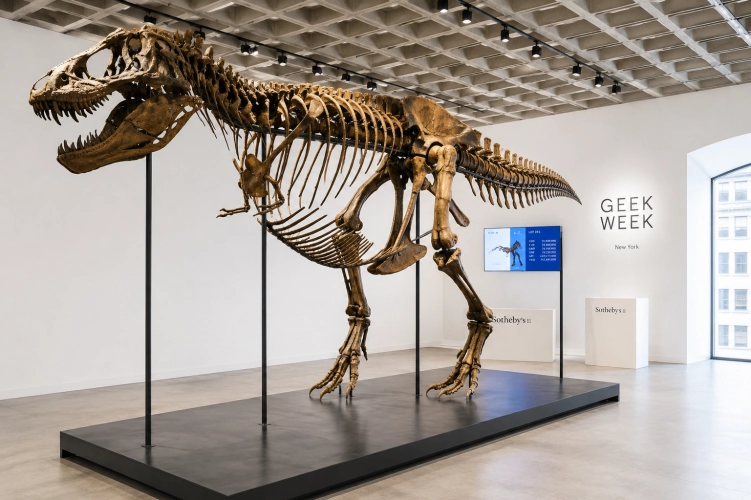
On July 14, 2026, the hammer fell at Sotheby’s in New York for over $50 million. The item up for auction was “Gus,” a Tyrannosaurus rex skeleton approximately 67 million years old. This makes Gus the most expensive dinosaur ever sold at auction.
For us at Fossiland, a sale like this is more than just a sensational headline. It shows where the market is headed. In this article, we’ll introduce the object of desire and analyze the trends behind this record-breaking sale.
The Object of Desire: Tyrannosaurus—Who Was “Gus”?
Gus was discovered in 2021 on a cattle ranch in the U.S. state of South Dakota. The animal is named after the late landowner Gary “Gus” Licking, on whose property the first bones were unearthed. He did not live to see the completed reconstruction of his find.
According to Sotheby’s, the recovery and preparation by Theropoda Expeditions took nearly five years. The result is impressive: The skeleton comprises 183 bone elements and is approximately 61 percent complete. The skull is 82 percent intact. Gus measures about 11.50 meters in length and 3.80 meters in height—one of the largest and most complete specimens ever found.
The traces left behind by the animal’s life are particularly fascinating. Cassandra Hatton, Sotheby’s natural history specialist, pointed out bite marks and healed bone fractures. These provide insights into what Gus went through during his lifetime.
The estimated price was between 20 and 30 million dollars. In the end, seven bidders drove the price up to 50.13 million dollars in a bidding war that lasted about ten minutes. The lot was sold to an anonymous bidder on the phone.
A trend that shows no signs of slowing down: “Investment Fossils”
This record didn’t come out of nowhere. It’s part of a trend we’ve been observing for years.
The previous record for a dinosaur fossil was held by “Apex,” a Stegosaurus skeleton. Ken Griffin, founder of the hedge fund Citadel, purchased it at auction at Sotheby’s in 2024 for $44.6 million. Today, Apex is on loan to the American Museum of Natural History in New York. Before that, the T. rex “Stan” had caused a sensation: It changed hands at Christie’s in 2020 for $31.8 million. And “Sue,” the first T. rex to be auctioned at Sotheby’s, fetched approximately $8.4 million back in 1997. Sue is now on display at the Field Museum in Chicago.
The message is clear: Top-tier T. rex skeletons are at the pinnacle of the collecting world. However, it would be a mistake to conclude from this that all dinosaur fossils are increasing in value. What makes Gus exceptional is not just the species or the price. It is the rare combination of quality, completeness, and the right timing that brought together seven determined bidders.
Why Not Every Fossil Benefits: Market Selection
This is exactly where we see how the market works today. Prices for mass-produced items and low-quality pieces have been declining for years. Select fossils, on the other hand, are in high demand. The buyer base has long since expanded beyond traditional collectors. Wealthy private collectors, museums, family offices, and international investors are also discovering top-quality fossils as a long-term investment in tangible assets.
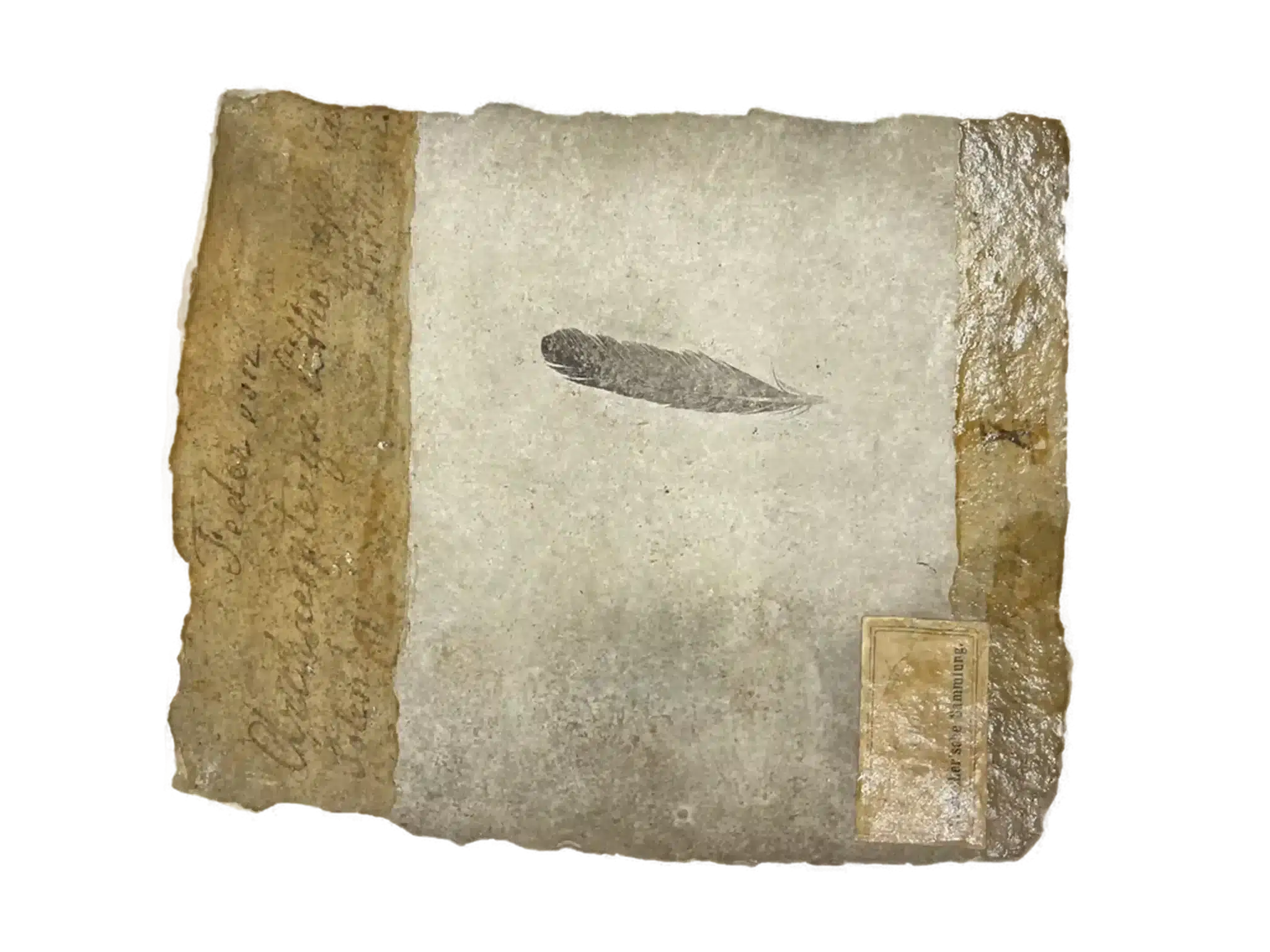
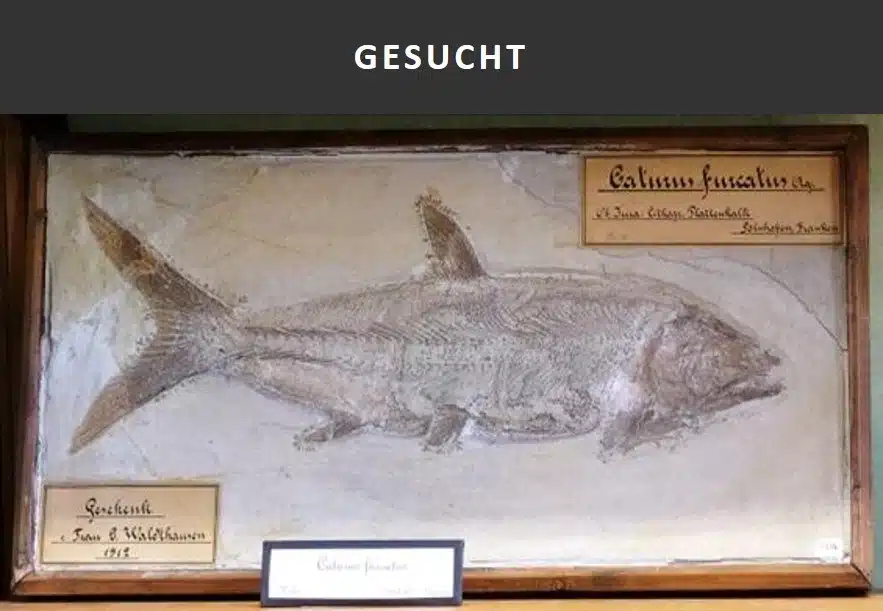
In the process, individual “world-renowned sites” have emerged. These include Cretaceous fossils from the United States—such as those from Montana, Wyoming, and South Dakota—the Jurassic slab limestones of Solnhofen, and the Posidonia shales from Holzmaden. In recent years, colorful ammolites from Canada have been added to this list.
Another striking fact is that relatively few market participants drive the market. They regularly supply the major auction houses and thus shape what actually becomes visible at the high end of the market.
From the Gold Rush to a Professional Network: Professionalization
As awareness of quality grows, so does a second awareness—that of proper documentation and clear provenance. The “Condition Report” has long been neglected. Today, it is noticeably gaining in importance.
In the past, buyers of high-priced fossils often settled for questionable certificates. A sticker reading “100% Original Fossil” was enough for many. Today, detailed information is required: on the fossil’s origin, its legal status, and the nature and extent of any restoration work.
The “gold rush” mentality of some dealers is thus giving way to a professional network of specialists. Geologists, taxidermists, conservators, scientists, and marketing experts now work closely together. Recovery, restoration, and marketing are all intertwined. It is no coincidence that Sotheby’s emphasized to Gus just how carefully the skeleton was recovered, documented, and prepared.
Paying with Bitcoin? Cryptocurrencies on the Rise
One final point stands out. Gus’s auction page at Sotheby’s explicitly stated “Cryptocurrency Accepted.” So while buyers are becoming more critical, auction houses are becoming less hesitant about cryptocurrencies such as Bitcoin or Ethereum.
This is a remarkable shift. On the one hand, there is more scrutiny and documentation; on the other, a payment method that would have been unthinkable just a few years ago. It will be fascinating to see how this develops.
What Remains of Tyrannosaurus rex, aka “Gus”
Gus is a one-of-a-kind piece—and the record price is the exception, not the rule. For collectors and sellers, the real lesson is this: quality, a clear provenance, and accurate documentation determine a piece’s value. That’s exactly what matters, even away from the big stage.
Sources
- Sotheby’s, New York: “Gus” – A Mounted Tyrannosaurus Rex Skeleton, “Natural History” Auction (July 14, 2026), lot page – including the note “Cryptocurrency Accepted,” among other details
- Sotheby’s: “Meet Gus the T. rex,” video on the excavation and preparation, sothebys.com
- The Washington Post: “‘Gus’ the T. rex sells for a record $50.1 million at auction” (July 14, 2026), washingtonpost.com
- CNN: “Rare T. rex fossil sells for a record $50.1 million at auction” (July 14, 2026), cnn.com
- CNN: “A T. rex found in South Dakota could smash auction records — and possibly disappear forever” (July 13, 2026), cnn.com – on the discovery, Gary Licking, and Theropoda Expeditions
- CNBC: “T. rex Sells for $50 Million, Becoming the Most Expensive Dinosaur Fossil Ever Auctioned” (July 14, 2026), cnbc.com – featuring a quote from Cassandra Hatton
- NPR: “Mystery bidder buys T. rex nicknamed ‘Gus’ for a record $50 million” (July 15, 2026), npr.org
- Artnet News: “Gus the T. Rex Nets $50 Million as Fossil Fever Rages” (July 14, 2026), news.artnet.com – regarding “Sue” (Field Museum, Chicago)
- Gizmodo: “I Can’t Afford This T. Rex Up for Auction at Sotheby’s” – on the approximately five-year recovery and preparation process by Theropoda Expeditions, gizmodo.com
- Science (AAAS): “Apex the Stegosaur, the most expensive dinosaur fossil ever sold, is headed to a museum” – Value: $44.6 million; on loan to the American Museum of Natural History, science.org
- Axios: “Dinosaur Fossil Sells for Record $44.6 Million at Auction” (July 18, 2024), axios.com
- Robb Report: “The $45 Million Stegosaurus Skeleton ‘Apex’ Is Now on View in N.Y.C.” – “Apex” (Ken Griffin) on loan to the AMNH, robbreport.com