
Advertisement: “Looking for Bundenbach fossils—Offering top prices—Free appraisal”
The Bundenbach Fossil Site—A Window into the Devonian Period
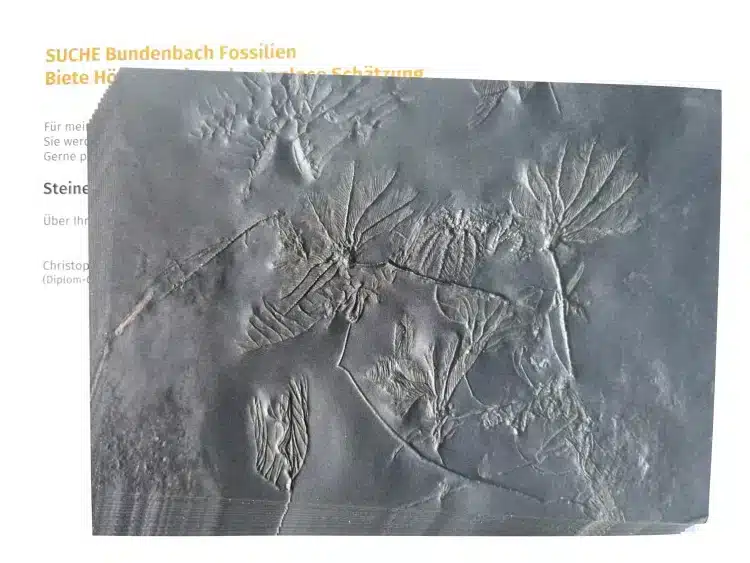
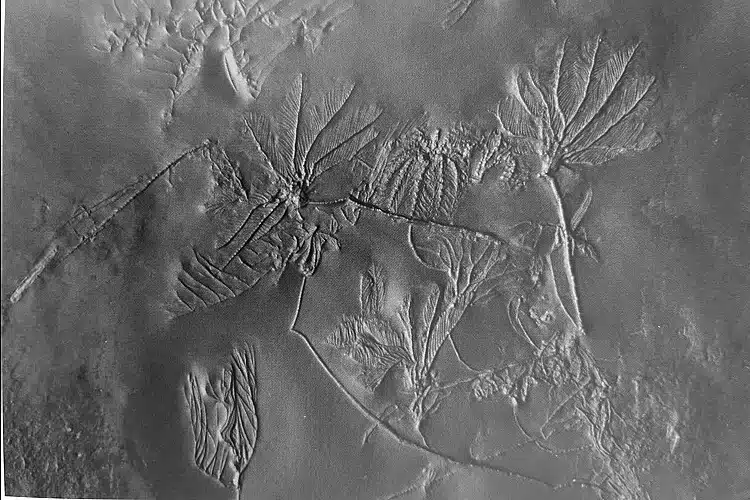
Every collector knows certain fossil sites. Bundenbach is one of them. This small town in the Hunsrück region is home to some of the most beautiful fossils Germany has to offer. Starfish that crawled across the seafloor some 400 million years ago are now embedded here in shale and pyrite—so finely preserved that they look as if they were fossilized just yesterday.
I collect these items and am looking to purchase old collections. This text explains what makes Bundenbach so special.
How old is the Hunsrück slate?
The Bundenbach fossils come from the Hunsrück Shale. This is a rock layer from the Lower Devonian, specifically the Emsian stage. It is about 400 million years old.
Back then, there were no low mountain ranges here—only a shallow sea. It was located near what was then the equator and was divided into separate basins. Bundenbach was situated in the so-called Wisper Trough. There, fine silt settled gently to the bottom without much current. It is precisely this stillness that explains why the fossils are so delicately preserved.
Over millions of years, the soft marine mud turned into the hard, black roofing slate we know today.
Why are the fossils so well-preserved?
The key is a mineral: pyrite, also known as fool’s gold.
After they died, the animals were quickly covered by mud. In the absence of oxygen, bacteria initiated a process in which parts of the bodies were replaced by iron sulfide. As a result, not only were the shells preserved, but often the soft tissues as well—arms, stalks, and the finest structures.
This has had two consequences that have made Bundenbach famous:
First, the pyritized fossil is harder than the surrounding shale. This makes it possible to expose it mechanically—in the past using a needle, and today also using fine abrasive material.
Second, pyrite is denser than rock when it comes to X-rays. This means a fossil can be X-rayed without destroying it. This technique was developed starting in the 1950s, primarily by physicists W. M. Lehmann and Wilhelm Stürmer. Suddenly, details that had been hidden within the rock became visible. This was a milestone for research.
From a scientific standpoint, Bundenbach is therefore classified as a fossil deposit—that is, one of the rare sites where not only hard shells but entire communities of organisms have been preserved.
What fossils can be found in Bundenbach?
The diversity is vast. Experts have identified over 190 genera and more than 270 species in the Hunsrück Shale. As a result, Bundenbach is considered the world’s most significant Devonian fossil site. The best-known groups are:
Asterozoa such as starfish. These are the classics among Bundenbach fossils. Species such as Urasterella or the pyrite-glistening Euzonosoma tischbeinianum are highly sought after by collectors. But also brittle stars. Delicately structured relatives of starfish, often with long, winding arms. Names like Furcaster, Bundenbachia, or Encrinaster crop up time and again.
Sea lilies (crinoids). Delicate stems and calyxes, some with a complete crown. Bactrocrinites is a well-known example.
Trilobites. These Paleozoic arthropods are often found in Bundenbach with their legs and antennae still intact—thanks to X-rays and pyrite.
Other arthropods and rare species. Unusual forms such as Mimetaster and Weinbergina are what make this site so fascinating for science and collectors.
In addition, there are clams, brachiopods (such as Orbiculoidea), snails, cephalopods, and plant remains. Hardly any other site provides such a complete picture of life in the Devonian sea.
How were the fossils discovered?
Not by searching for fossils—but by looking at roof slate.
For centuries, slate was mined in the Hunsrück, primarily for roofing. More than 600 small quarries are known to exist around Bundenbach. At first, the fossils were merely a byproduct. Miners set aside beautiful slabs, which caught the attention of collectors and researchers, and thus, over generations, a rich collection of Bundenbach fossils was amassed.
This background also explains why so many pieces are in private hands today: they often date from a time when mining was still active.
Why are Bundenbach fossils in demand today?
Because hardly any new material is being added. Slate mining has almost completely come to a standstill. In the fossil-rich main region around Bundenbach, only a single quarry remains open today. New discoveries have become rare.
At the same time, awareness of the value of this site is growing. In 2024 and 2025, hundreds of citizens and numerous professors of paleontology signed a petition calling for a new fossil museum in Bundenbach and for the protection of the site. For collectors, this means that once a fossil has been recovered, only a limited quantity remains. As a result, high-quality, well-preserved, and carefully prepared specimens are becoming increasingly valuable. Old family collections, in particular, often contain real treasures—sometimes without the owners even realizing it.
Would you like to part with your Hunsrück slate collection?
I’m looking for Bundenbach fossils for my collection—both individual specimens and entire collections. Whether they’re mounted or still in the raw slab, whether it’s a single starfish or a whole cabinet full of slate slabs—I’d love to take a look at what you have.
What I offer:
- Fair maximum prices for high-quality Bundenbach fossils.
- A free appraisal —even if you decide not to sell in the end.
If necessary, just send me a photo—feel free to send it via email or WhatsApp. I’ll get back to you right away.
More info


