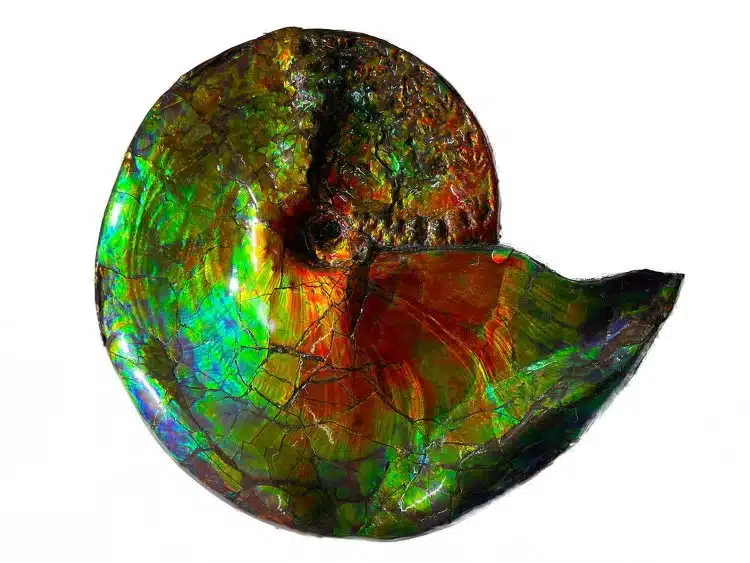
Ammolite is one of the most spectacular fossils. When the shells of ammonites—millions of years old—shine in all the colors of the rainbow, they captivate collectors, investors, and jewelry lovers alike. But while the market has been electrified for years by claims of a “300% increase in value over 10 years,” it’s worth taking a critical look behind the scenes.
Rainbow-colored ammolite—a physical nanowonder
Ammolite consists of the fossilized mother-of-pearl of the ammonite species Placenticeras meeki, Placenticeras intercalare, and, rarely, Baculites compressus, which lived about 75 million years ago.
The fact that the highly sensitive aragonite, of which the mother-of-pearl is composed, was not transformed into ordinary calcite or completely dissolved over this immense span of time is due to a geological anomaly. Periodic volcanic eruptions in the forming Rocky Mountains covered the shells—which had sunk to the seafloor—with water-impermeable volcanic ash (bentonite clay). This sealing protected the shells from oxygen, circulating groundwater, and thermal overheating above 400 °C.
Schematic Geological Profile of the Bearpaw Formation (Alberta, Canada):
▼ Approx. 15–30 meters deep
┌────────────────────────────────────────────────────────────────────────┐
K-ZONE
-> “Crush Material” is severely fragmented by rock pressure
-> Siderite concretions, mostly red and green in color (Dragon Skin)
└────────────────────────────────────────────────────────────────────────┘
▼ Approx. 50–65 meters deep
┌────────────────────────────────────────────────────────────────────────┐
BLUE ZONE / ZONE 4
-> “Sheet Material”: flat, compressed slabs that are largely unbroken
-> Pyrite and clay layers, the source of the rare AAA blue/violet hues
└────────────────────────────────────────────────────────────────────────┘
A breakthrough published in *Scientific Reports* in 2025 (Hizukuri et al.) revealed the microscopic secret behind the extreme color saturation of Canadian ammolite. The iridescence is caused by structural coloring resulting from light interference, rather than by pigments:
- The Nanogaps: Under an electron microscope, it can be seen that tiny air gaps (nanogaps), only 4 nanometers wide, have been preserved between the perfectly parallel layers of aragonite in Canadian ammolite.
- The thickness of the shell determines the color: When light strikes this lattice structure, it is reflected at precise wavelengths. Thicker layers of aragonite (approx. 190 nm) reflect long wavelengths—resulting in the common red and green hues. Extremely thin, fragile layers (approx. 140 nm) refract the light into short wavelengths, producing the highly sought-after blue and violet hues. If an ammolite is ground into powder, this microarchitecture is destroyed, leaving behind a pale brown mineral aggregate.
Monopoly Structures and the “De Beers Principle”
Anyone who talks about ammolite as an investment must understand how the market works. In reality, there is no true, free competition when it comes to this gemstone.
For decades, Korite International held a near-complete monopoly and controlled up to 95% of the world’s commercial deposits in the Saint Mary River Valley in Alberta. In 2025, a major merger took place: the Indigenous mining company Buffalo Rock Mining (led by members of the local Kainai Nation / Blood Tribe), previously its only competitor, acquired Korite. As a result, exclusive “mine-to-market” control—from large-scale open-pit mining and stabilization laboratories to jewelry production and exclusive global distribution—passed entirely into a single entity’s hands.
Why prices are being kept consistently high:
- Controlled market launch: Similar to the De Beers diamond cartel in the 20th century, the producer controls the flow of raw materials. A glut in the market is deliberately prevented in order to maintain exclusivity.
- The Asian Connection: The massive price surge of over 300% over the past decade was fueled by Feng Shui grandmasters in Asia (Hong Kong, Singapore, China). There, ammolite is marketed as the “Seven Color Prosperity Stone” in the high-end luxury segment.
- The absolute discovery rate: Each year, an estimated 200 ammonite shells of (semi-)precious stone quality are recovered from the Bearpaw Formation.
Workshop Secrets: Composites and Reaching into the Bag of Tricks
For fossil collectors, the most critical consideration when purchasing a large specimen is this question: How much of the original natural material remains in the rock? Since the fossilized color layer is usually only a wafer-thin 0.1 to 0.8 millimeters thick and extremely brittle, almost nothing can be done in the commercial trade without artificial aids.
1. The Matrix Illusion: Original in situ vs. mounted
Magnificent, vibrantly colored ammonites that appear to protrude three-dimensionally from their original, dark matrix fetch top prices. The reality, however, is that nearly all large specimens in matrix on the market are montages.
Since the Bearpaw Formation consists of unstable, brittle clay shale, the blocks shatter uncontrollably during excavation. The delicate ammonite shell is recovered separately, chemically and mechanically stabilized, and then glued onto and fitted into an artificially modeled or external, stable matrix plate (often a mixture of clay shale and cement). A genuine, undisturbed in-situ specimen, in which the rock and fossil were extracted from the ground as an inseparable unit, is an absolute paleontological rarity.
2. Mosaic ammonite or composite
The practice of reassembly, known from many other sites, does not stop at high-priced ammolites either: fragments from several specimens (ideally of the same species) are assembled into a new, complete specimen. The transitions at the fracture edges are sometimes concealed so perfectly by embedded aragonite platelets that they are barely noticeable.
3. The Most Common Post-Processing Techniques in the Lab
- Vacuum Injection with Cyanoacrylate & Opticon: To prevent the mother-of-pearl from flaking off during mechanical exposure with a pneumatic bur, the raw material is permanently impregnated with extremely low-viscosity superglue. The final finish is usually applied under vacuum using optical polymers (e.g., Opticon or UV-stabilized epoxy resin) to completely seal the pores.
- Dark backing (color activation): Since the fossil aragonite is partially transparent, a light-colored backing would scatter the light and make the colors appear pale. Taxidermists therefore specifically use jet-black epoxy adhesive under the shell. The black absorbs excess light and makes the iridescence shine.
- Crack Filling: The characteristic cracks in the “dragon skin” (K-zone) are often filled with resins mixed with dark pigments or original rock powder to conceal imperfections.
- Doublets & Triplets: In the jewelry industry, the wafer-thin layer of ammolite is bonded to slate or onyx (doublet) and, in the case of rings, is coated with a hard protective layer of synthetic spinel or rock crystal (triplet), which raises the Mohs hardness from a soft 3.5 to 8, making it suitable for everyday wear.
The Problem with Ageing Resistance
The most critical issue for long-term collectors concerns the chemistry behind the stabilization process.
Over the course of decades, polymers and epoxy resins are highly susceptible to environmental influences, which can lead to three effects:
- UV yellowing: The plastic oxidizes when exposed to sunlight. Under certain conditions, the crystal-clear resin may develop a yellow or amber tint. Since the play of colors in ammolite is based on precise light interference at the nanometer scale, a yellowed layer filters out short-wavelength light (blue and violet)—causing the stone to lose its brilliance.
- Delamination: Plastics and fossil calcium carbonate (aragonite) have significantly different coefficients of thermal expansion. Temperature fluctuations create stresses at the interface, leading to microcracks. If the resin delaminates locally, light is refracted incorrectly, resulting in opaque, milky-white spots.
- Brittleness: Over the years, plasticizers leach out of the resin. The surface develops very fine hairline cracks (crazing). Once aged, the deeply embedded plastic cannot be removed chemically; the damage is irreversible.
Collector’s Guide: What Determines the Value of an Ammolite?
If you want to evaluate an ammolite fossil as a collector or investor, you should consider gemmological and paleontological criteria.
The CIBJO Grading System (Alphabetical System)
The system used by the Colored Stones Commission of the World Jewelry Confederation (CIBJO) is officially recognized. Terms such as “AAA” are purely marketing inventions.
| CIBJO Grade | Required Criteria for Valuation | Market Relevance & Value Stability |
| AA | At least 3 clear, brilliant colors (full spectrum including blue/violet); excellent luminosity from all viewing angles (360° color play). | Highest investment potential. A rare, genuine collectible with intrinsic value. |
| A+ | At least 2 vibrant, contrasting colors; the color pattern remains clearly visible over a rotation angle of more than 240°. | High-end collector’s grade with strong demand in the design sector. |
| A | One or more clear colors, visible at a viewing angle of over 180°. | Standard collectible item, primarily for decorative purposes. |
| A- | Good colors, but lower brightness; the color effect disappears when rotated more than 90°. | Souvenir and mass market. Hardly any potential for appreciation. |
Official Registration: The “Disposition Certificate”
Under Alberta’s extremely strict fossil protection law (the Historical Resources Act), every fossil found in the ground legally belongs to the Government of Canada. Before a complete ammonite shell may be commercially exploited or exported, it must be submitted to the Royal Tyrrell Museum of Paleontology.
If the scientists release the specimen, it is assigned an official, unique specimen number (e.g., KB-2401) and a state-issued disposition certificate.
Be cautious with “exotic finds”: Occasionally, iridescent ammonite shells from Madagascar are sold as inexpensive “ammolite.” Physically, however, these specimens lack both the fine aragonite layering and the shell thickness required to achieve the brilliance of genuine Canadian material.
Conclusion
Ammolite is a fascinating hybrid: It is the dazzling result of an ultra-rare, millions-of-years-old quirk of nature—and at the same time, the prime example of a luxury craze perfectly orchestrated by marketing. According to Korite, reserves will be depleted in 20 years; the value will rise by 300% in 10 years…
Anyone looking for a crisis-proof investment in tangible assets and willing to invest between €25,000 and €75,000—depending on quality—should specifically seek out certified pieces of CIBJO Class AA with a documented Canadian export number. There are many indications that the hype surrounding ammolites and the price rally will continue.
For the purists among collectors, the question arises as to whether they want to spend so much money on a “Plastinat”—a fossil impregnated with resin and completely encased in plastic. The durability of the plastic coatings raises questions. But those who don’t think in geological time scales will delight in these spectacles of nature.
Sources
Hizukuri, N., Oshima, Y., Yagi, Y., & Imai, H.: “Brilliant structural colors originating from reflection by nanogaps in the nacreous layers of fossilized ammonite shells.” – Scientific Reports, Vol. 15, Article No. 37541, 2025 (DOI).
MINING.COM: “KORITE Acquisition in Alberta Creates the World’s Largest Mine-to-Market Ammolite Producer” (article dated August 1, 2025).
Government of Alberta / Royal Tyrrell Museum of Paleontology: “Ammolite to Become an Official Provincial Emblem” (press release dated March 24, 2022).
Royal Tyrrell Museum of Paleontology: Found a Fossil? – Distribution of Ammonite Shells in Alberta: tyrrellmuseum.com
International Gem Society (IGS): Ammolite – Value, Price, and Jewelry Information: gemsociety.org
Ammolite Canada: “How Rare Is Ammolite?”: ammolitecanada.ca