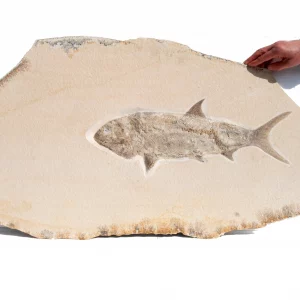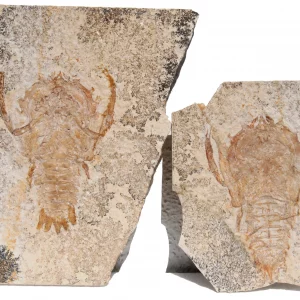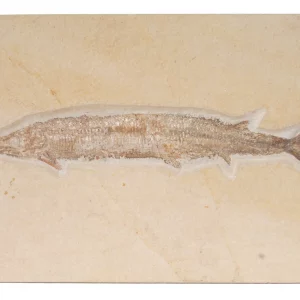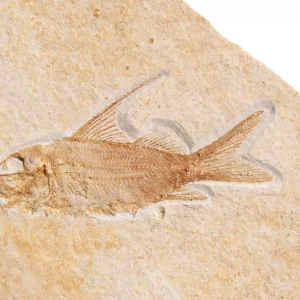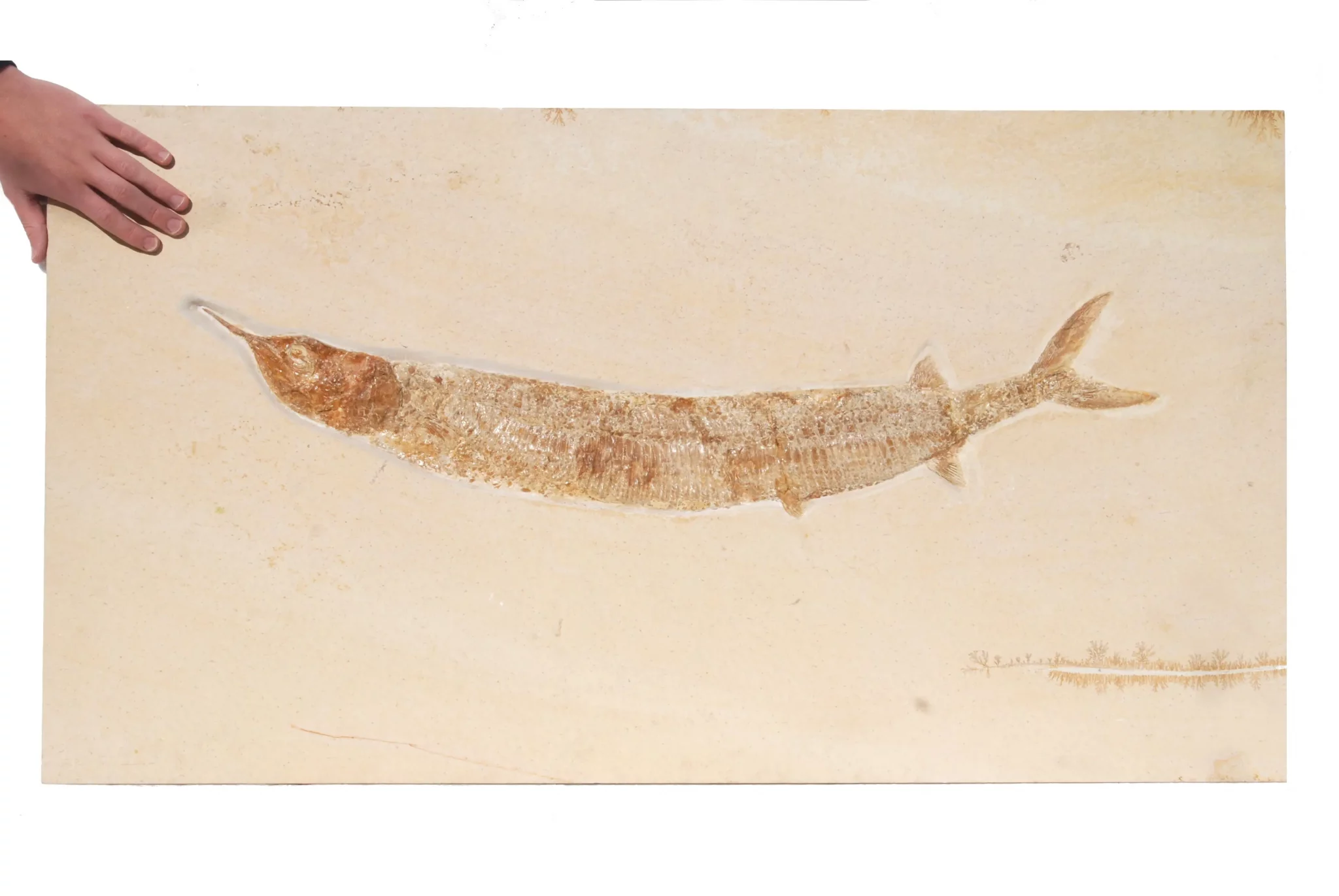
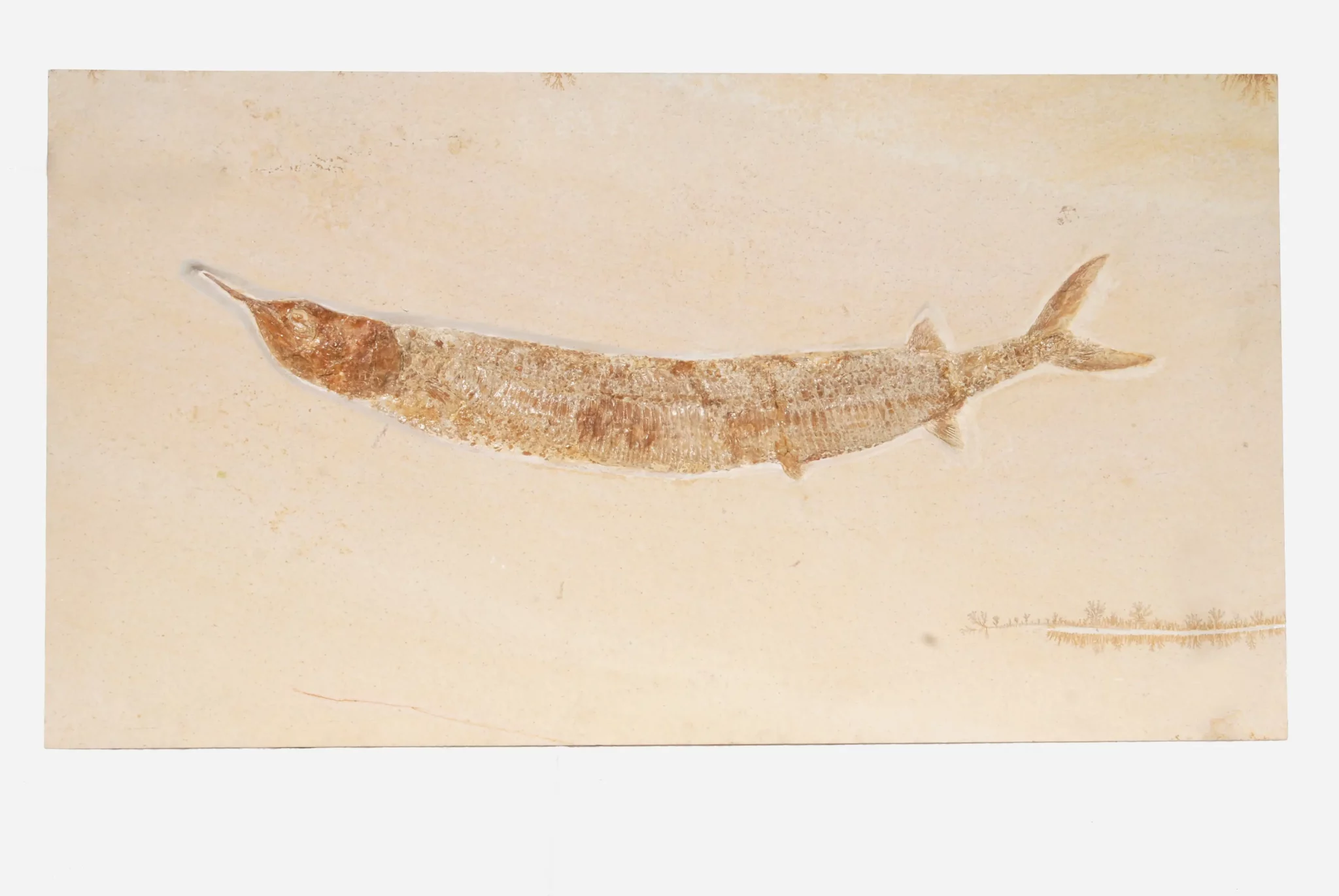
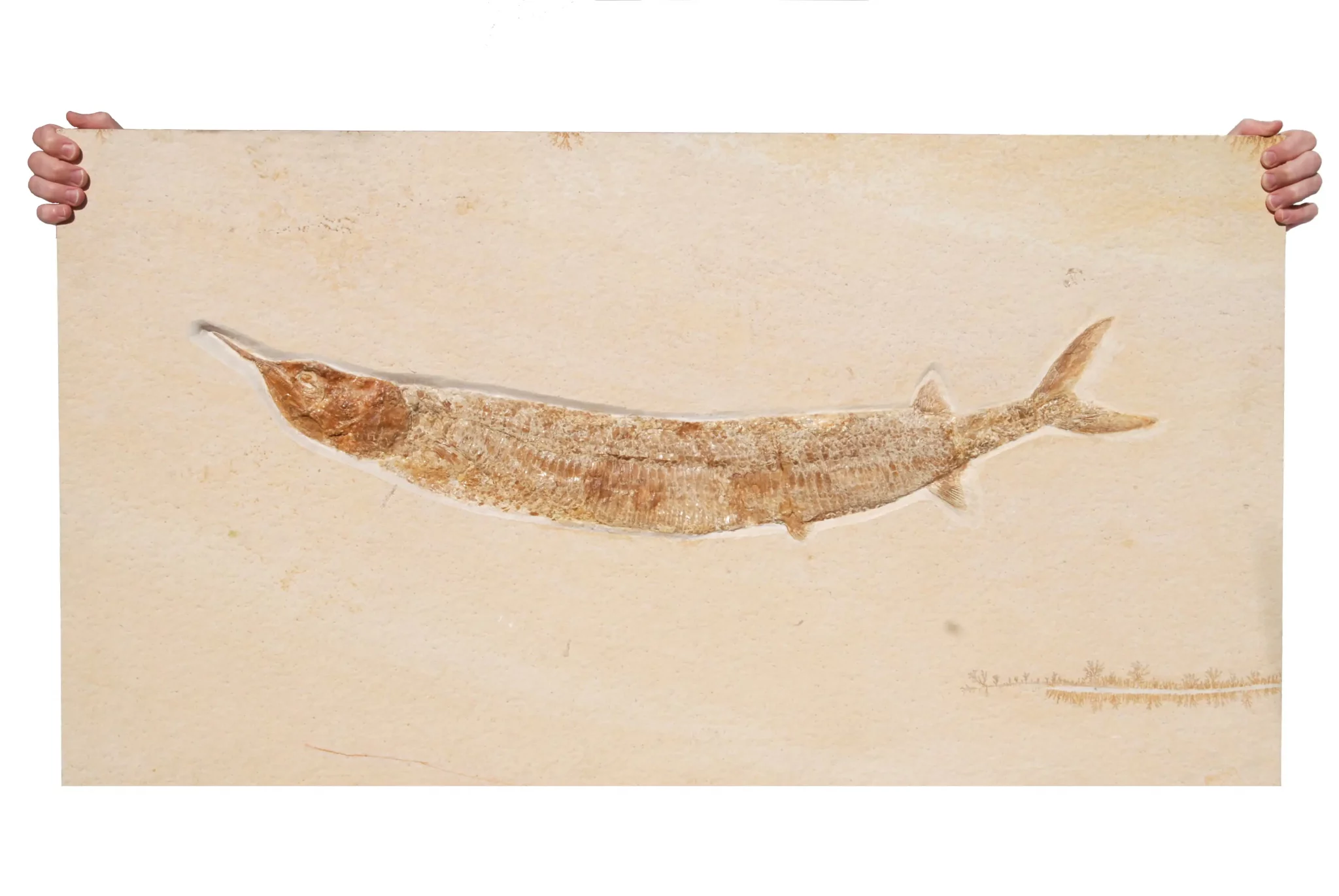
Solnhofen Aspidorhynchus acutirostris XXL
Place of discovery: Langenaltheim, Langenaltheimer Haardt; Solnhofener Revier/ Germany
Lithostratigraphy: Lower Tithonian, White Jurassic Group, Altmühltal Formation, Upper Solnhofen Subformation
Biostratigraphy: Hybonotum zone, rueppelianus subzone, rueppelianus horizon
Age: approx. 150.8 – 152 million years +/- 2 million years
Panel size: 110 x 60 cm
Fossil size: 90 cm (largest size)
Huge, decorative “beaked fish” with bright scales and teeth.
Typical composite. With proof of provenance
Offered on behalf of the customer. Please do not make a payment in the store. Sale in the name and for the account of the owner.
Aspidorhynchus acutirostris – The highly specialized Jurassic hunter
One of the easiest fishes to identify from the Solnhofen limestones. As a member of the Aspidorhynchidae, it is characterized by an extremely elongated, almost needle-like body and a characteristic rostrum. This specialized predatory fish occupied the ecological niche of a fast predator in the Upper Jurassic, comparable to today’s garfish or barracuda.
Scientific classification and morphology
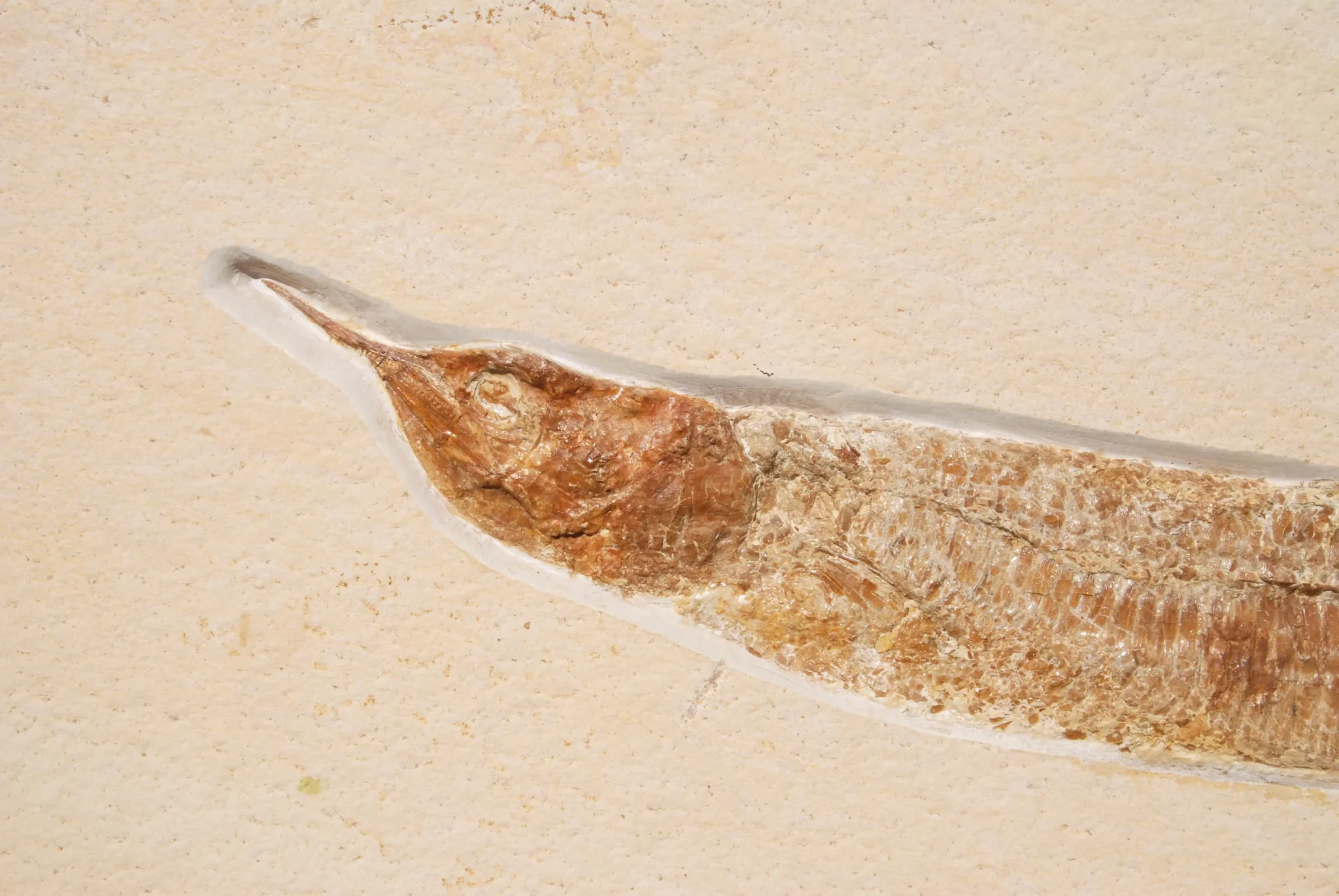
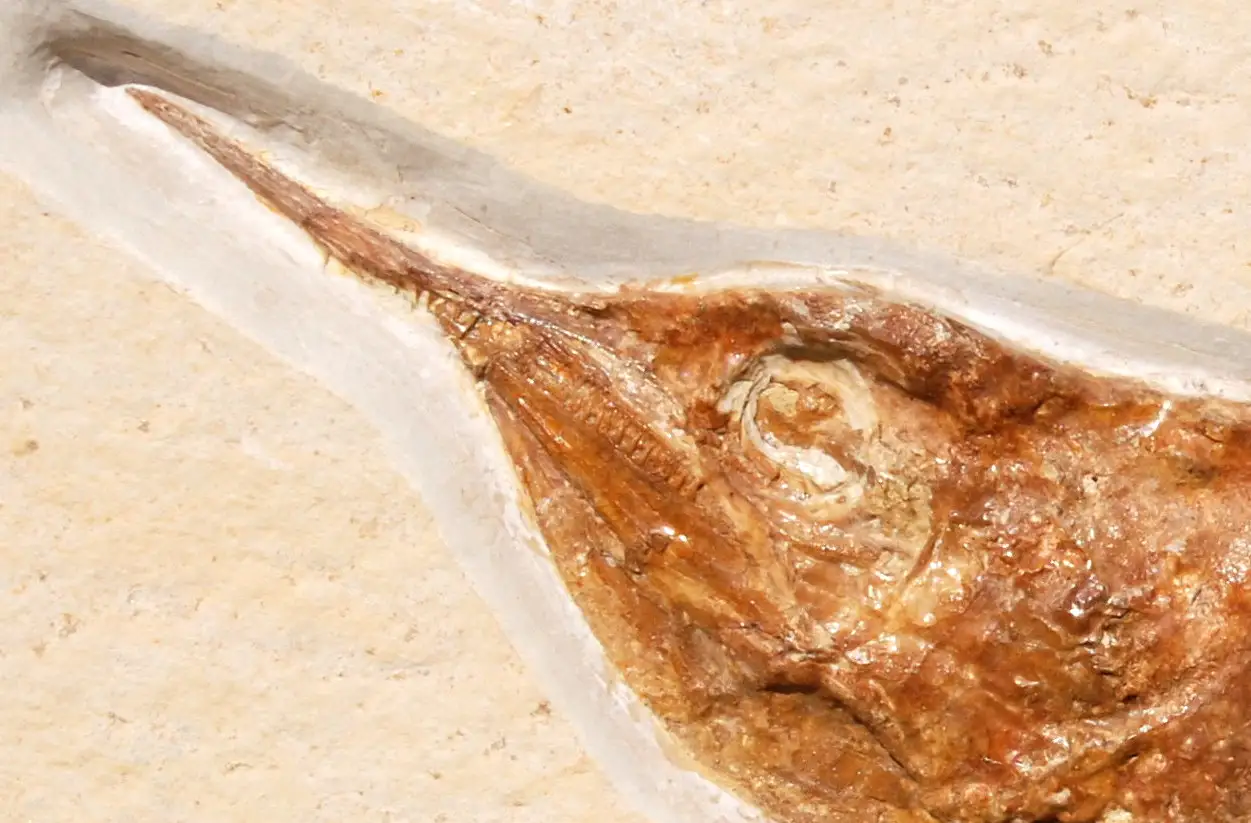
- The rostrum: The most striking feature is the extension of the upper jaw into a pointed, bony beak (rostrum) that protrudes far beyond the lower jaw. This tool was presumably used to injure or unbalance prey fish at high attack speeds.
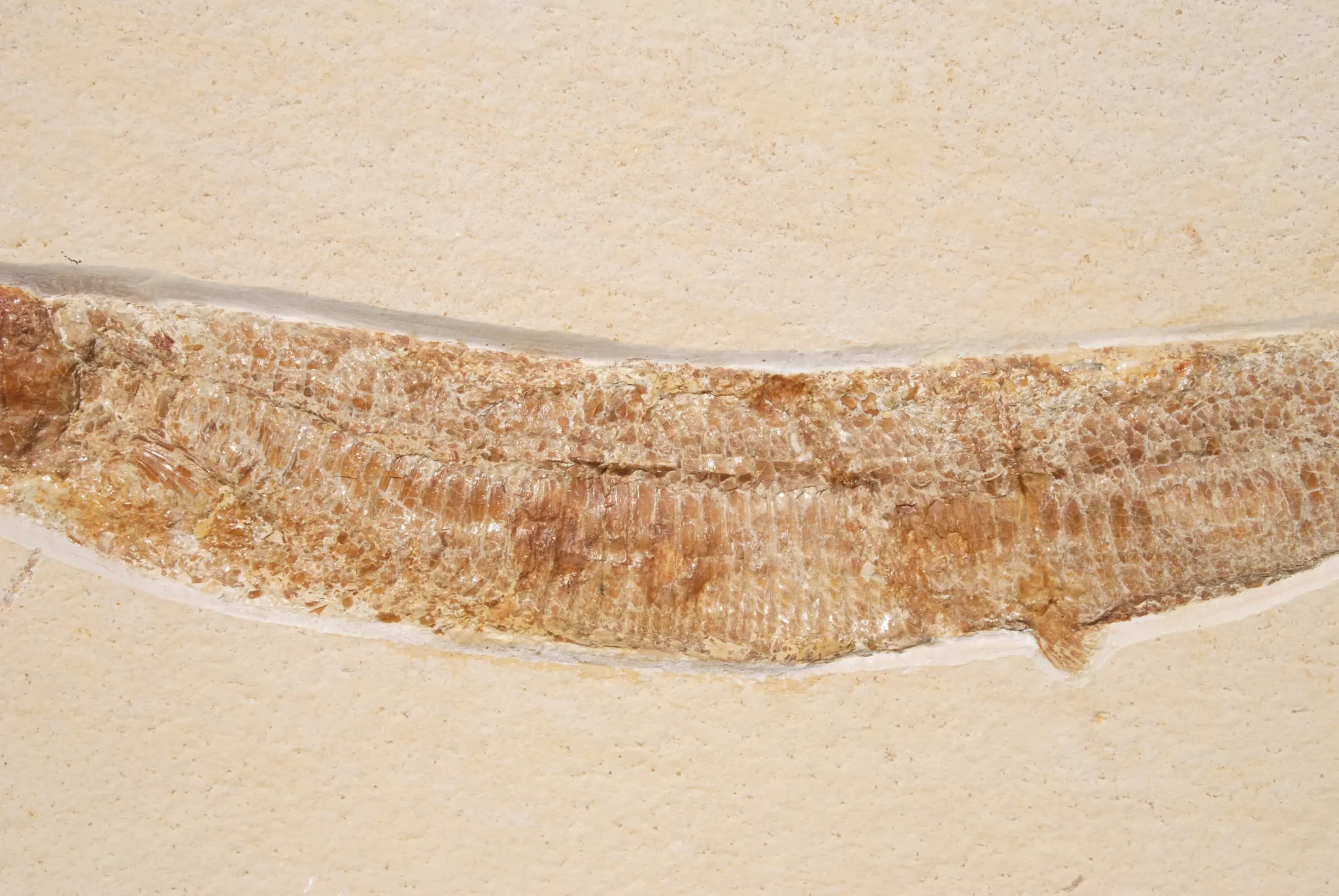
- Armor: The body is covered by massive, high ganoid scales arranged in vertical rows. This armor gave the fish great stability, but limited its lateral flexibility, making it a classic straight-line sprinter.
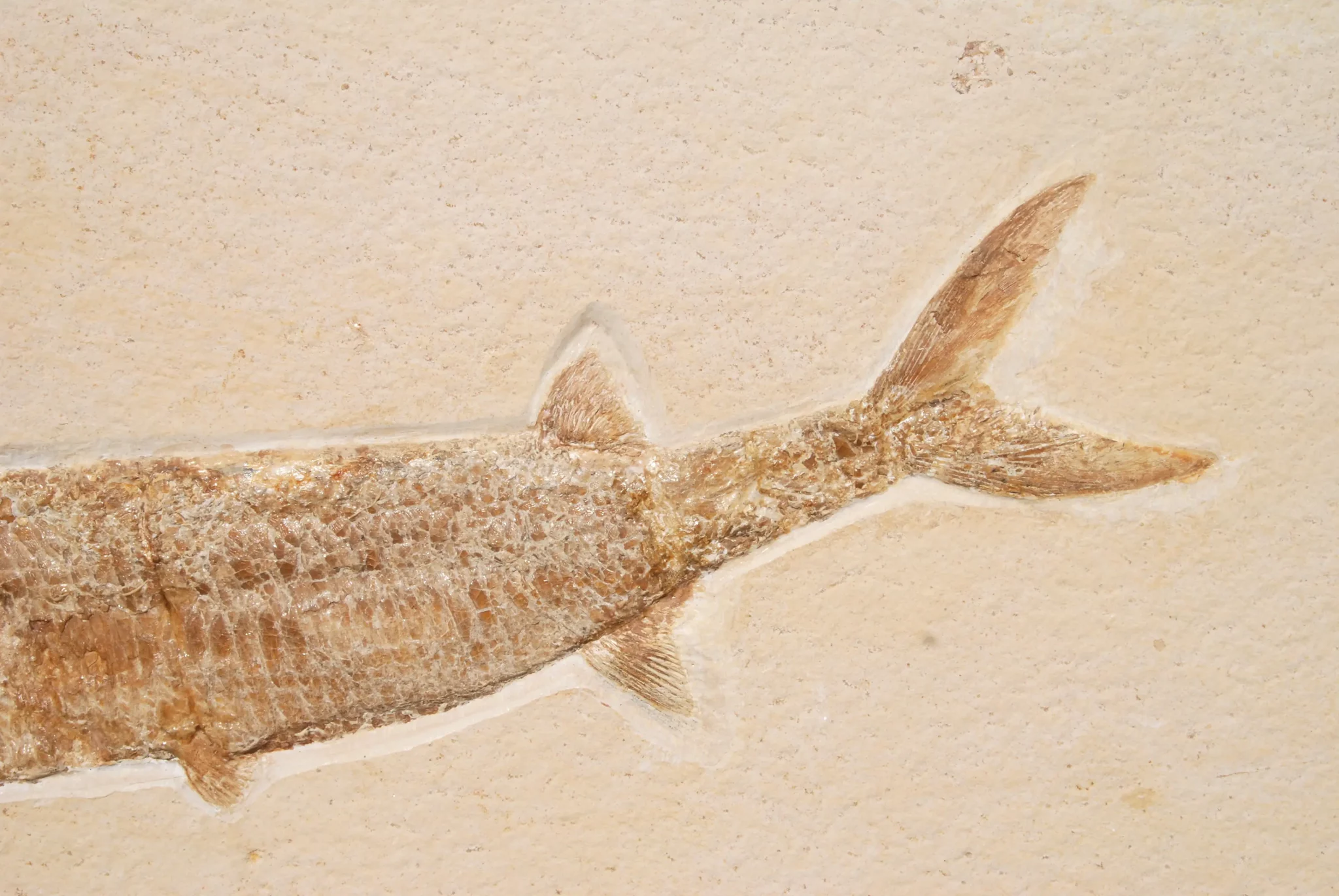
- Fin arrangement: To achieve maximum acceleration, the dorsal and anal fins are shifted far back and are almost symmetrically opposite each other – a typical characteristic of predators.
The fine details – what collectors look out for:
- The scale rows: In this genus, the vertical arrangement of the flank scales is often preserved in excellent symmetry. The metallic sheen of the enamel layer (ganoin) remains stable for millions of years if well preserved.
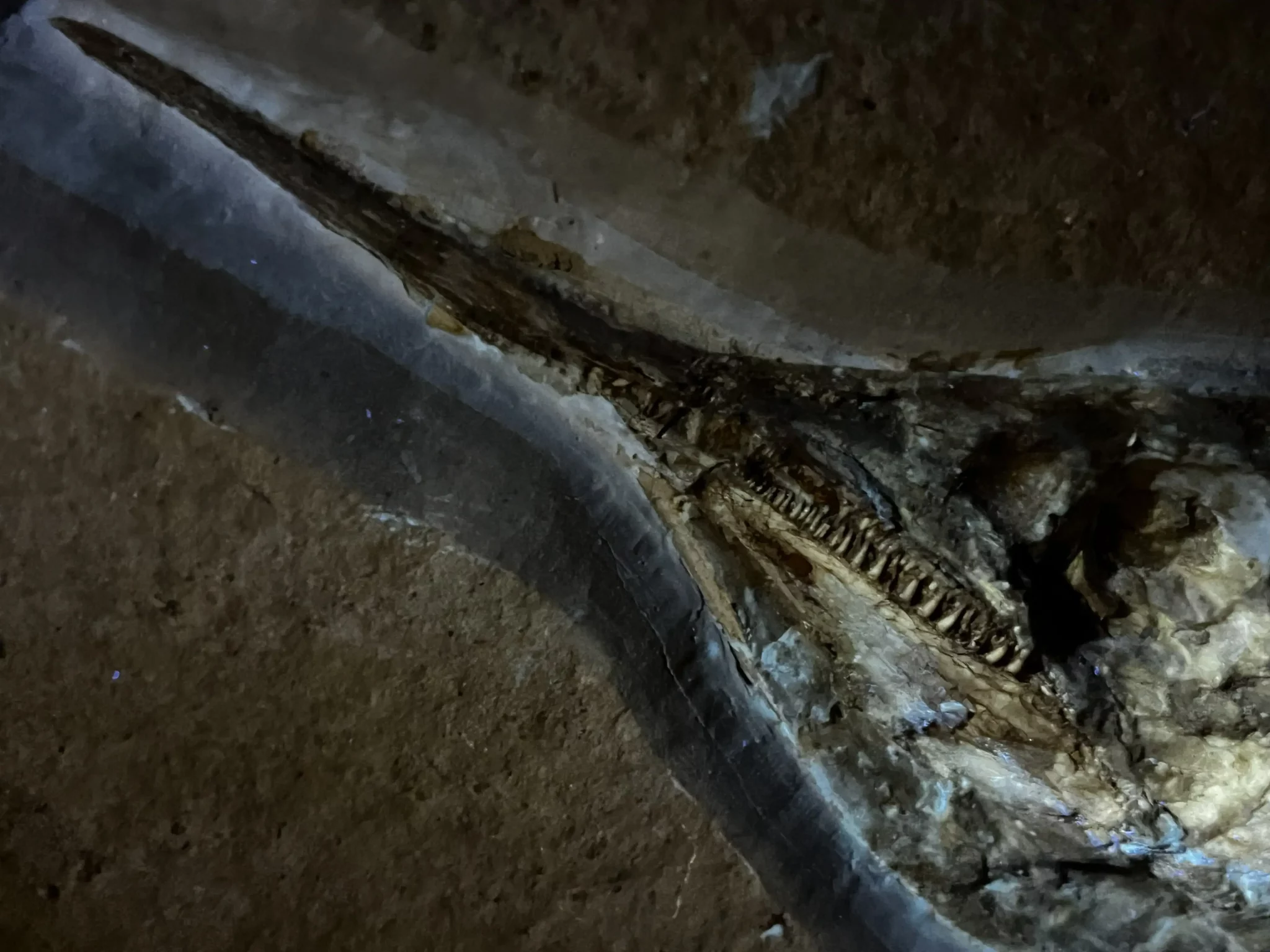
- Skull and dentition: Collectors pay particular attention to the tip of the rostrum and the dentition. The jaws are covered with numerous small, pointed teeth, which are clearly visible under the binoculars in high-quality specimens.
- Articulation: Due to the rigid armor, most specimens are found in a very straight, aesthetic line. In curved preservation, placed in the center of the slab, this fossil comes into its own dynamically.
A highlight for every Solnhofen collection
Aspidorhynchus is the perfect object for collectors who want to document the highly efficient hunting strategies of the Jurassic Sea. It represents the pinnacle of evolutionary adaptation to speed and precision in an ecosystem that was characterized by extreme competition.