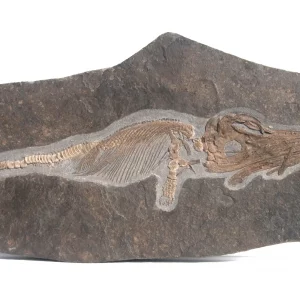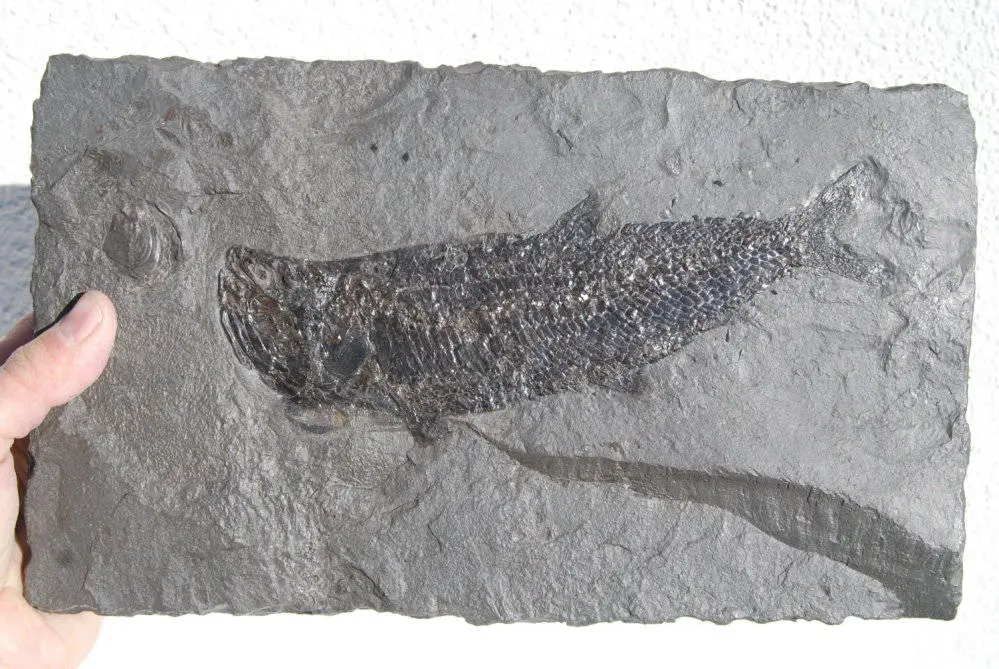
Pholidophorus bechei
33.5x20x3x1.5 cm (matrix)
Holzmaden; Lias Epsilon II/4
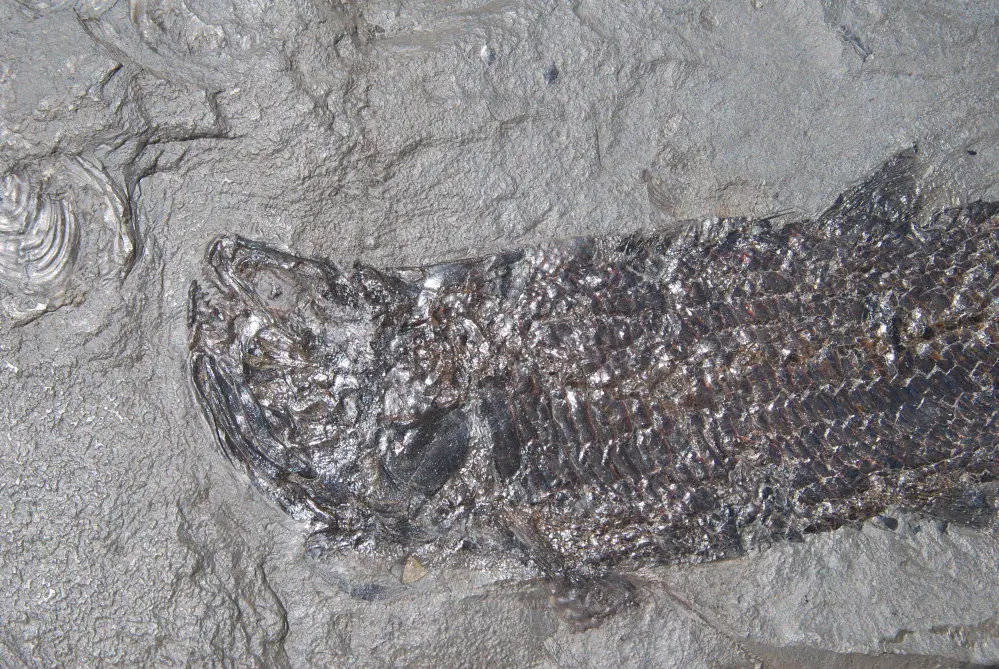
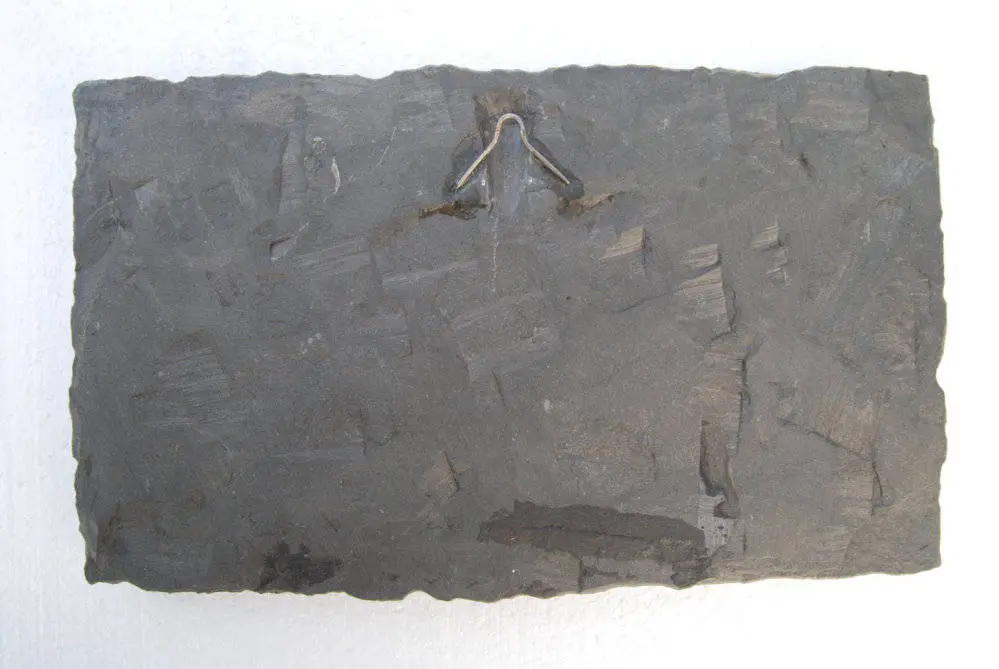
Complete, very rare fish, excellent preservation, all original, zero restoration, detailed teeth and scleral eye ring, on natural matrix, plate with wall-hanging mold. A museum quality piece for the serious collector. Offered nowhere else.
sold
The forerunner of modernity: Pholidophorus from Holzmaden
Pholidophorus is a smaller but evolutionarily highly significant bony fish from the early Jurassic. It is considered to be one of the earliest representatives, which already anticipated many features of modern bony fishes (Teleostei). It is often found in large numbers in the fossil-rich layers of Holzmaden, which shows it to be an important part of the Jurassic food chain.
Biology and lifestyle
A classic schooling fish. With its moderate size of usually 10 to 20 centimetres and its slender, spindle-shaped body, it was perfectly adapted to a life in open water (pelagic).
Its biology marks a turning point in evolution: while many of its contemporaries were still heavily armored and rather cumbersome, Pholidophorus relied on lightweight construction and speed. It already had a largely ossified skeleton, which made it more stable and lighter at the same time. As an agile hunter, it fed primarily on plankton and small invertebrates, while it itself was the main prey for larger predatory fish such as Hypsocormus or for marine dinosaurs.
The scaly coat: shine and protection
Although it already had modern features, it was still covered with the ganoid scales typical of the era.
- Structure: These scales were thinner and lighter than those of the massive Lepidotes species, but still covered with a shiny layer of ganoin.
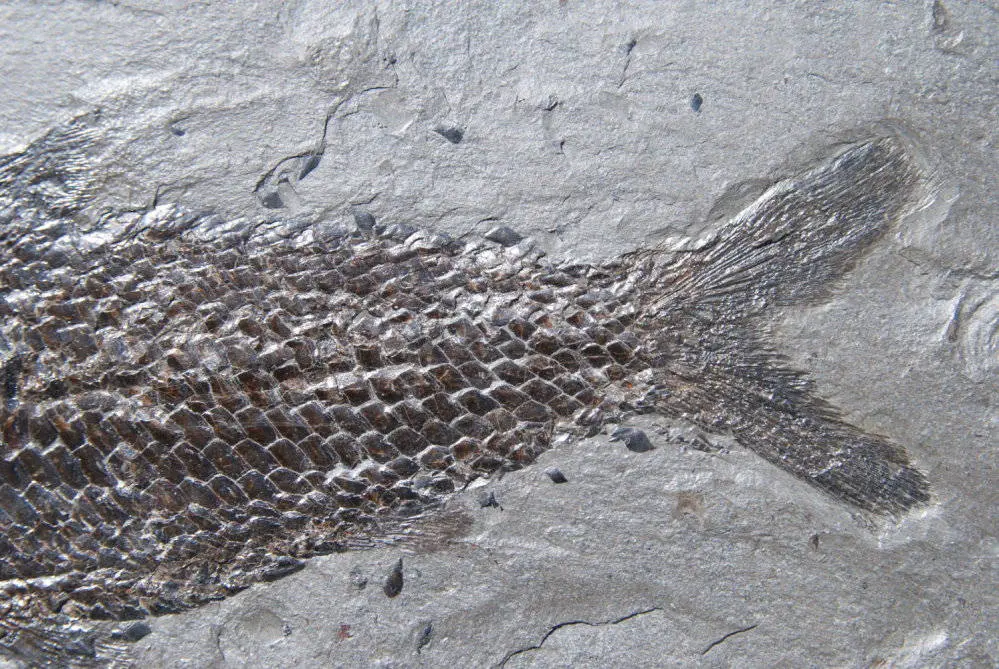
- Appearance: In the fossil they often have a silvery to bluish sheen. The scales are arranged in regular rows and give the fish an almost textile texture on the slate.
The special feature of the Holzmaden finds
Due to the excellent preservation of Posidonia slate, the finest details are often visible.
- Completeness: Complete swarms are often found on a plate, which offers a fascinating insight into the social behavior of these animals.
- Filigree structures: The fine fin rays and the head bones are often so precisely preserved that they can be examined under a microscope.
This fossil is far more than just a “small fish” – it is a living example of the evolutionary success that paved the way for the more than 30,000 species of bony fish that exist today. A must for any collection documenting the evolution of vertebrates.