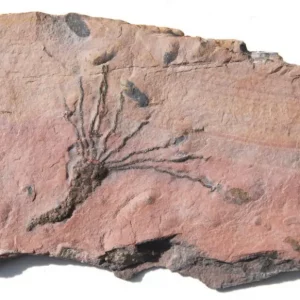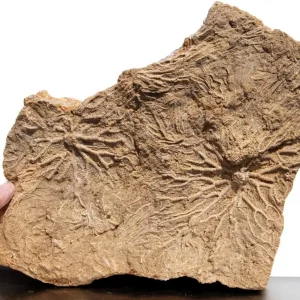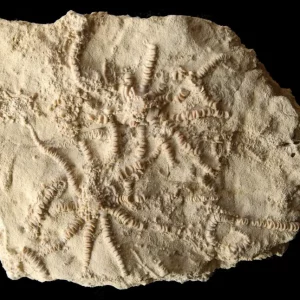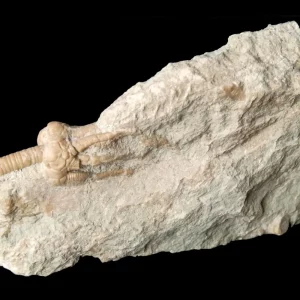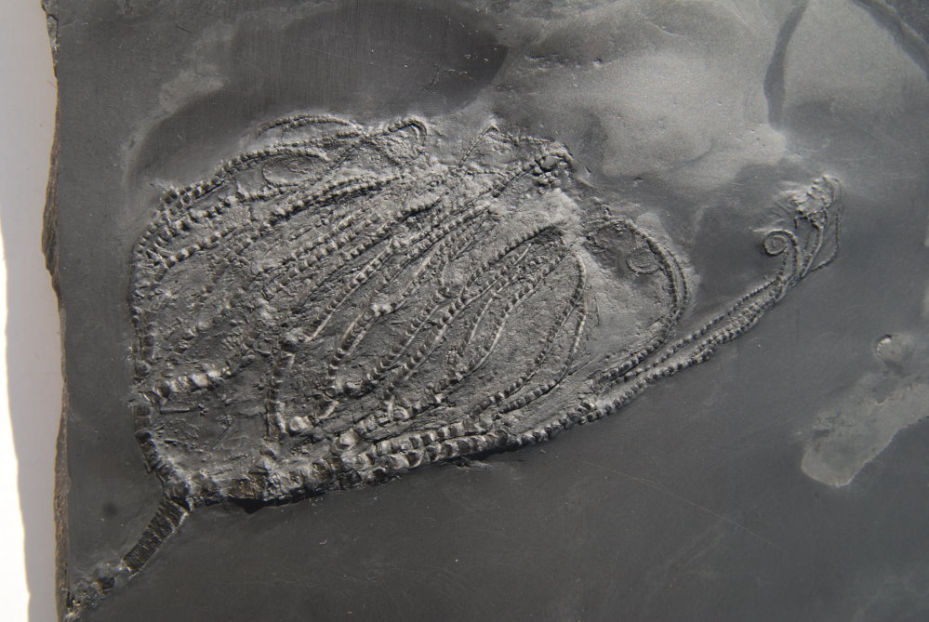
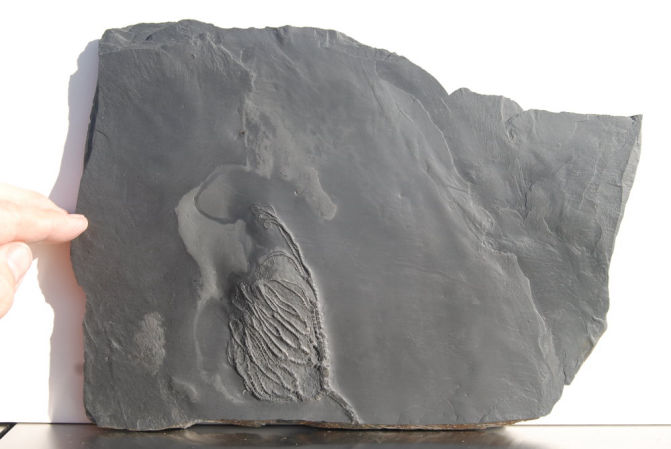
Bundenbach Taxocrinus stuertzii
12 cm (fossil), 20×26 cm (matrix)
Bundenbach; Obereschenbach pit
Aesthetic sea lily on a large, unbroken plate, rich in detail.
Taxocrinus stuertzii – The flexible giant of the Hunsrück slate
Unique in its class: a triumph of evolution among crinoids.
In a world full of rigid armor, this species is a sensation. As the only prominent representative of the Flexibilia subclass in the Hunsrück Shale, it shatters the usual image of Devonian crinoids. Where others relied on rigid shells, Taxocrinus opted for flexibility – a strategy that makes it one of the most fascinating collector’s items ever.
The exclusive characteristics – what makes Taxocrinus stuertzii so special:
- The miracle of flexibility: The most characteristic feature is the connection between the calyx and the arms. Unlike in almost all other species, the lower limbs are not rigidly integrated into the calyx. They remained flexible, giving the fossil an incomparably lively, organic dynamic even in the rock.
- The “curved” crown: The arms of this genus follow an impressive construction plan: They bifurcate dichotomously a total of four times. After the third bifurcation, something unique happens: the ends of the arms become remarkably thin and curve protectively over the calyx – an elegant picture of perfect symmetry.
- Purism without pinnulae: In contrast to many other crinoids, this animal has no pinnulae (lateral branches). This lack of “filling material” directs the viewer’s focus fully onto the powerful, clear structure of the main arms.
- A world-class handle: The dimensions of the handle are also record-breaking. It can reach a length of up to one meter and is exceptionally strong. A particular highlight for specialists are the sometimes long, forked cirrus (holding appendages), which give the stem additional complexity.
A milestone for systematics from Bundenbach
If you want to document the diversity of crinoids, Taxocrinus stuertzii is a must. It represents a completely independent evolutionary path. Its soft, flexible structure means that it is often preserved in the slate in particularly aesthetic, almost “dancing” poses.
A piece for Bundenbach collectors who are looking for something special. Its rarity as the only representative of the Flexibilia and the sheer size of its stem make it an undisputed star. A piece of geological history that shows that adaptability was the key to success 400 million years ago.