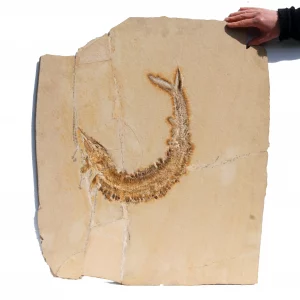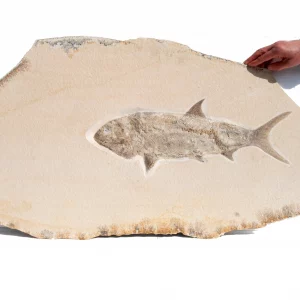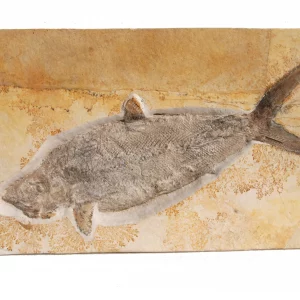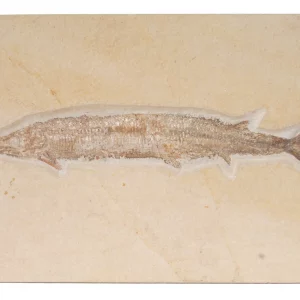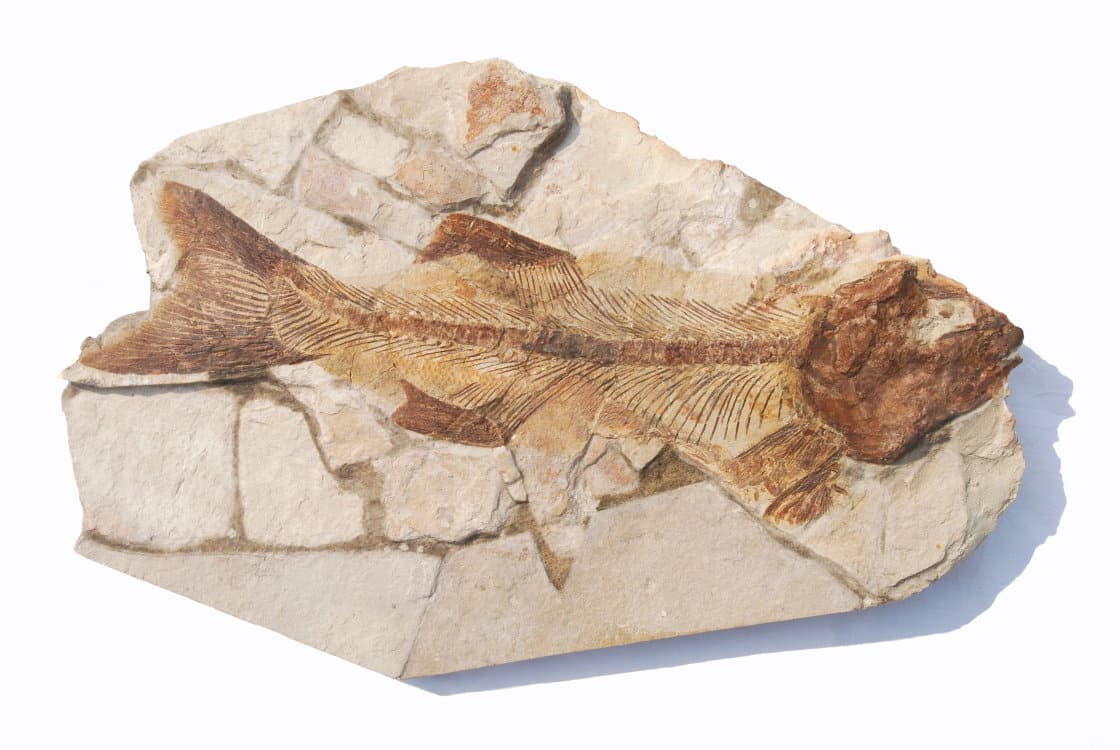
Solnhofen Ionoscopus sp.
53.5×24 cm (matrix)
Solnhofener Revier, Plattenkalke, Bavaria, Germany (exact location will be communicated to buyer)
Historic collector’s item with a special excavation history. Found approx. 50 years ago, contemporary preparation with restorations, in original matrix, not reburied.
Offered on behalf of the customer.
no longer available – sold on a commission basis on behalf of and for the account of the owner.
Ionoscopus – A specialized predatory fish of the Solnhofen archipelago
The genus Ionoscopus belongs to the order Ionoscopiformes and is a striking representative of the predatory fish fauna within the Upper Jurassic limestones. It is often mentioned in the shadow of the better-known Caturus, but differs in significant anatomical features that make it particularly interesting for scientifically oriented collections.
Scientific classification and morphology
-
- Anatomical distinction: Compared to other contemporary predators, Ionoscopus is characterized by a strong, rather stocky build and a massive skull. Characteristic is the large, deep mouth, which suggests a wide range of prey.
- The sensory system: A special feature of ionoscopids is the structure of the eye region and the skull roof, which indicates a highly developed visual orientation in the light-flooded lagoons.
- Taxonomic significance: As the eponymous genus of its family, Ionoscopus provides important data on the evolution of the Halecomorphi (a group of bony fishes that includes the modern pike).
Characteristics of fossil preservation – analysis for the collector:
- Skull architecture: In Ionoscopus, the cap bones of the skull are often very robust. For collectors, the integrity of the operculum (gill cover) and mandible (lower jaw) is a decisive criterion for the quality of the specimen.
- Fin morphology: Compared to Caturus, the dorsal fin is often shorter and sits further back on the body. The caudal fin is strong and shows the slightly asymmetrical (hemi-heterocercal) structure typical of this group, which enabled high acceleration.
- Scales: The scales are usually thinner than in the heavily armored semionotids, but are visible as a fine, regular structure on the matrix when well preserved.
A highlight for every Solnhofen collection
Ionoscopus is the ideal specimen for collectors who want to document the complexity of food chains in the Jurassic Sea. It represents a specialized lineage of hunters in an ecosystem that was characterized by extreme biological diversity. Such a fossil is not only a rare find, but a window into the evolution of modern bony fishes in the middle of the subtropical Solnhofen Archipelago.