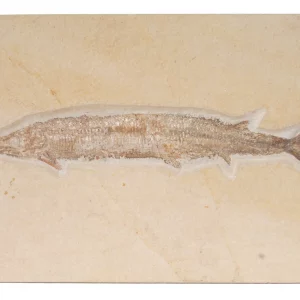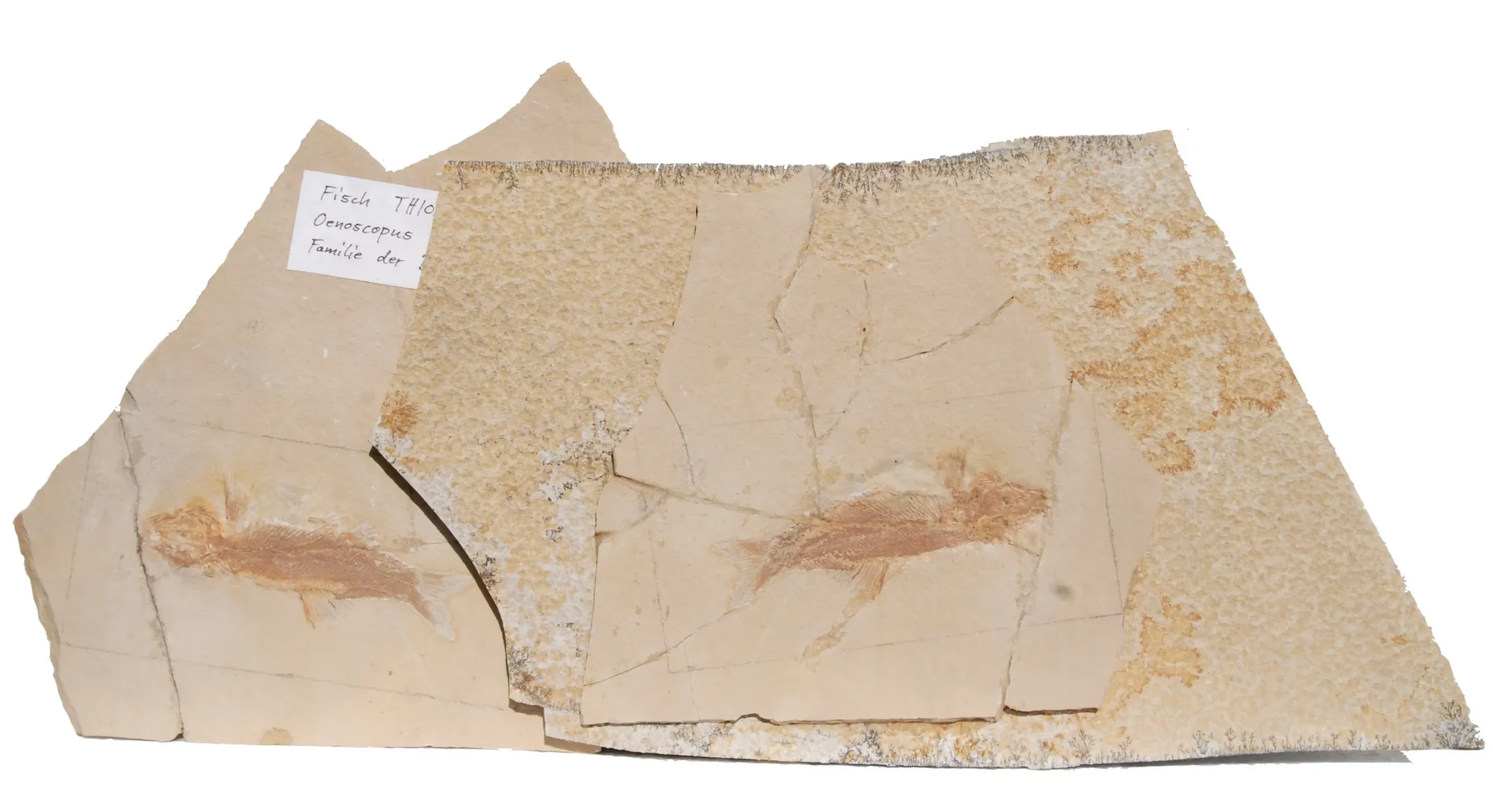
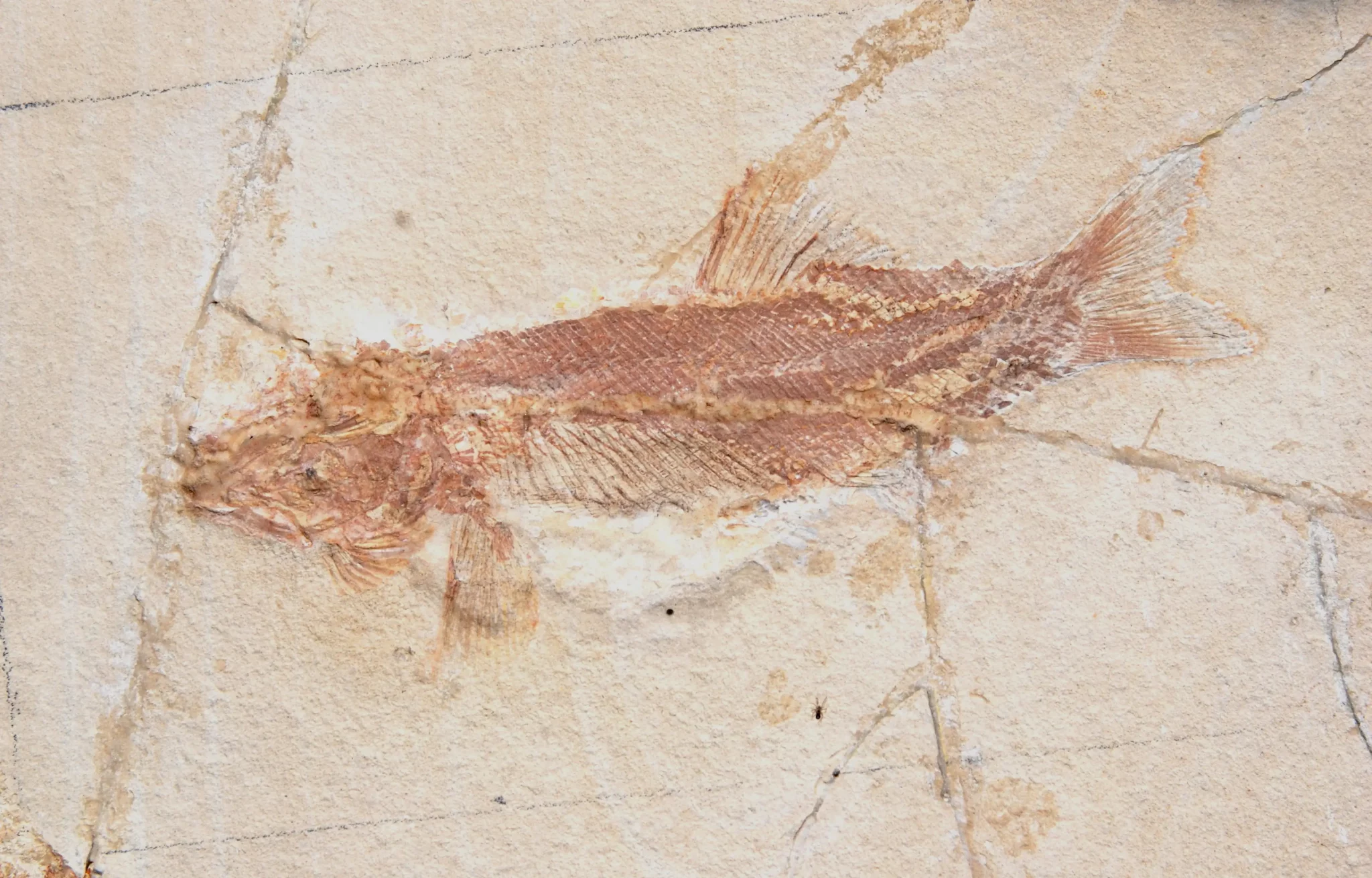
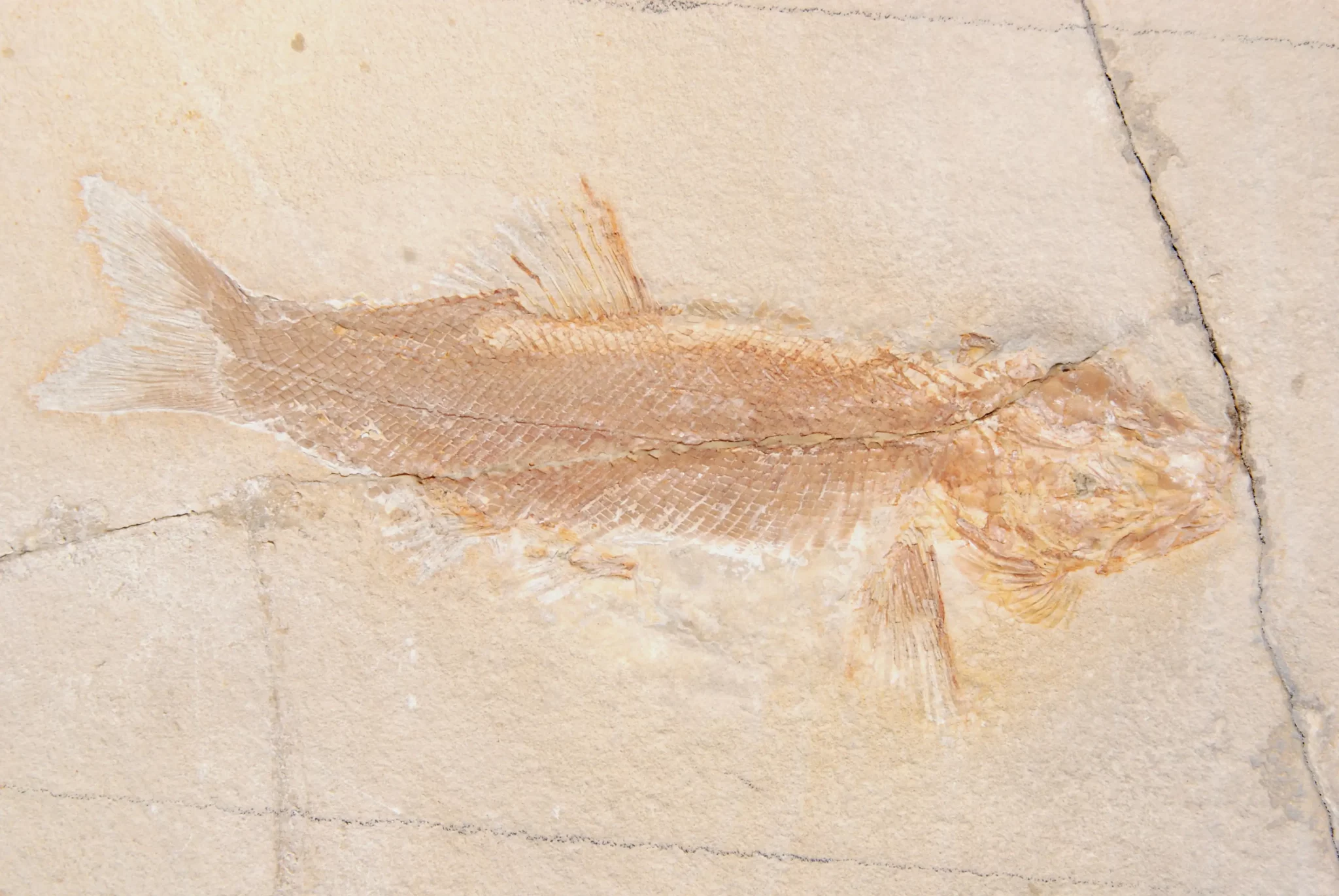
Solnhofen Furo sp.
Place of discovery: Langenaltheim, Langenaltheimer Haardt; Solnhofener Revier/ Germany
Lithostratigraphy: Lower Tithonian, White Jurassic Group, Altmühltal Formation, Upper Solnhofen Subformation
Biostratigraphy: Hybonotum zone, rueppelianus subzone, rueppelianus horizon
Age: approx. 150.8 – 152 million years +/- 2 million years
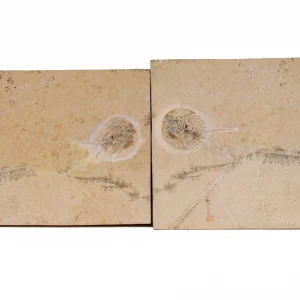
Size plate/counter plate: 40 x 24 cm / 21 x 21 cm
Size of fossil: 13.5 cm (largest size)
“Ray fin” in original found condition with potential at a low price.
Originally determined as “broomfish” Oenoscopus desori. Authentic fossil in original matrix, not reburied. With proof of provenance.
Offered on behalf of the customer. Please do not make a payment in the store. Sale in the name and for the account of the owner.
Furo – The elegant hunter of the Jurassic Sea
This fossil represents one of the most perfectly formed predatory fish from the Upper Jurassic Solnhofen Archipelago (approx. 150 million years ago). As a close relative of the caturids, Furo embodies the perfect balance between speed and agility in the subtropical lagoons of Bavaria.
Scientific classification and morphology
- Evolutionary elegance: Furo belongs to the Ionoscopiformes and is a fascinating example of a highly evolved bony scaler. With its slender, spindle-shaped body, it specialized in capturing smaller prey fish at lightning speed from ambush or in quick pursuit.
- The “hunter’s instinct” in stone: In contrast to the more massive Caturus, Furo often appears more delicate and graceful. In the fossil record, specimens of this genus are regularly found in dynamic curves that have frozen the moment of the last hunt or a quick escape movement in the limestone for eternity.
- Aesthetics of symmetry: The elongated silhouette and the even arrangement of the fins give Furo a special graphic quality. The fine structures of the rows of scales and the spine often stand out with photographic precision on the light-colored slab limestone.
The fine details – what collectors look out for:
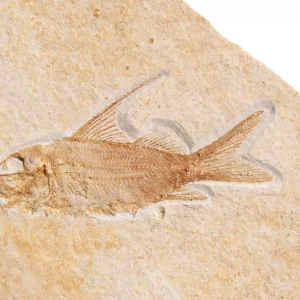
- The characteristic fin position: An important characteristic for Furo is the position of the dorsal fin, which usually starts well behind the middle of the body. In top specimens, the fan-like fin rays of the dorsal and anal fins are fully extended and show no signs of damage.
- The pointed robber’s skull: pay attention to the proportions! Furo has a relatively long, pointed head with a deeply split mouth. A high-quality collector’s item reveals the fine, pointed teeth along the edges of the jaw, which were optimized for holding small, slippery prey.
- The shiny scales: Furo’s ganoid scales are small and diamond-shaped. They often have a beautiful, natural enamel sheen. If the scales are in their natural articulation – i.e. without gaps or displacements – it is a museum-quality specimen of the highest rarity value.
A highlight for every Solnhofen collection
Furo is the ideal exhibit for collectors who want to document the diversity of Jurassic predators. It closes the gap between the massive predators and the smaller schooling fish.