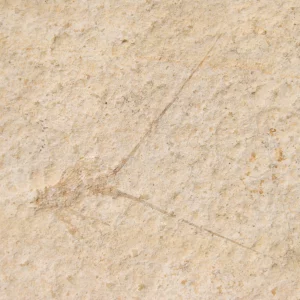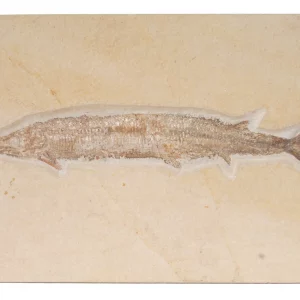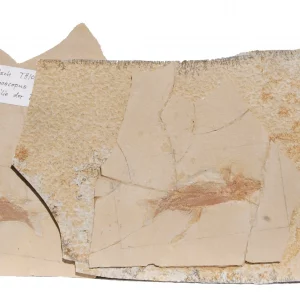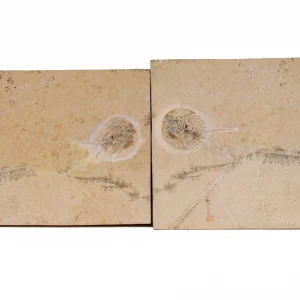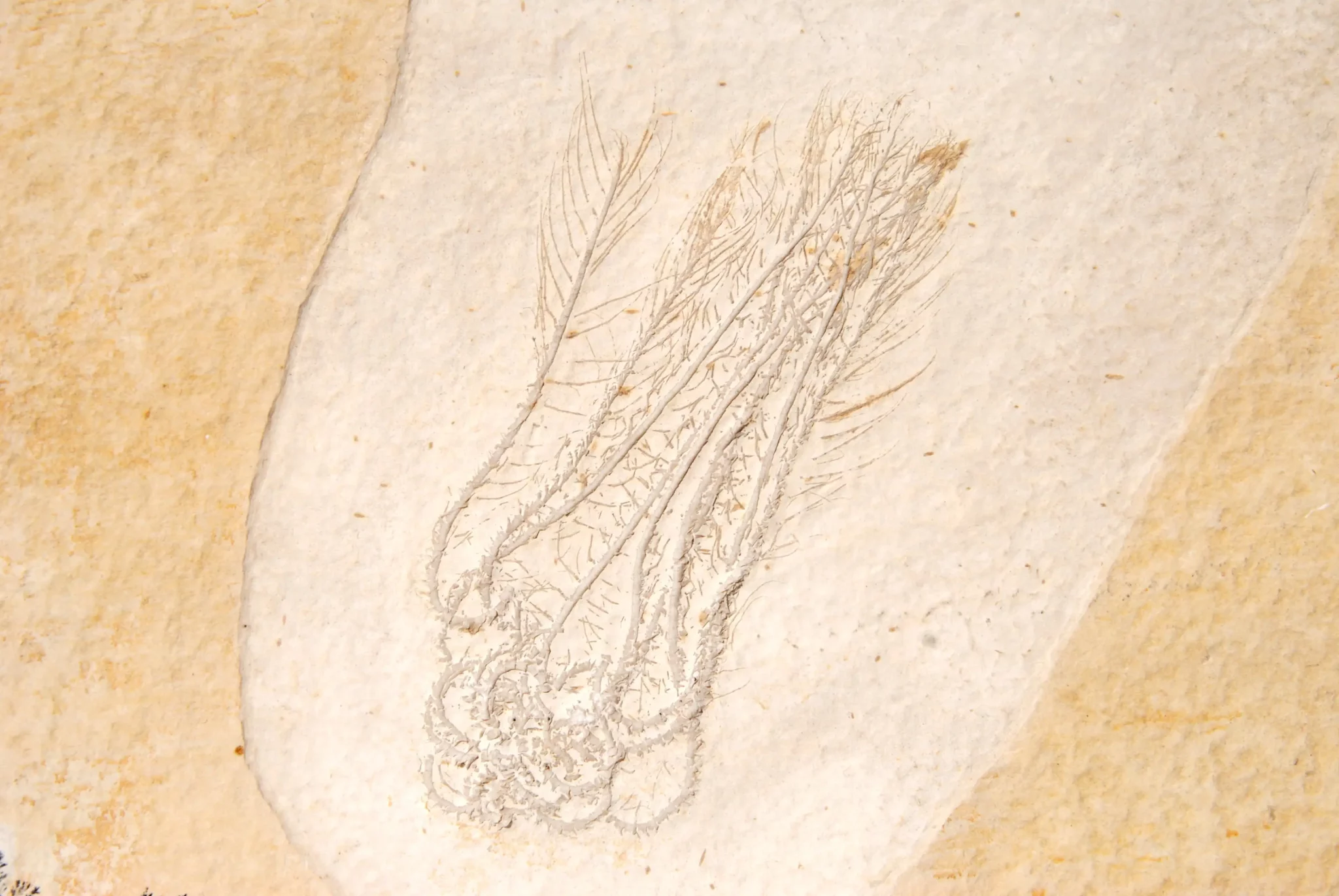
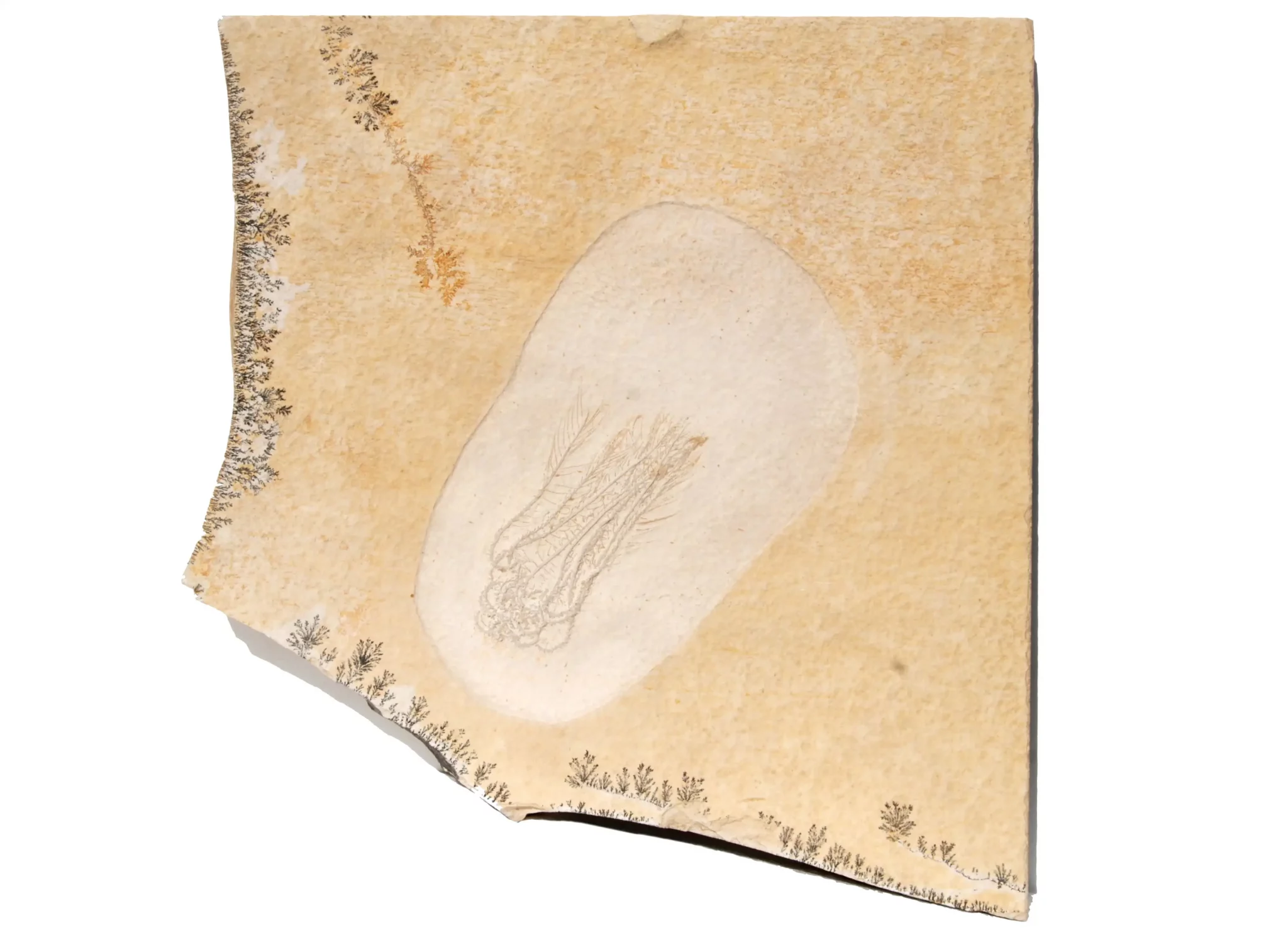
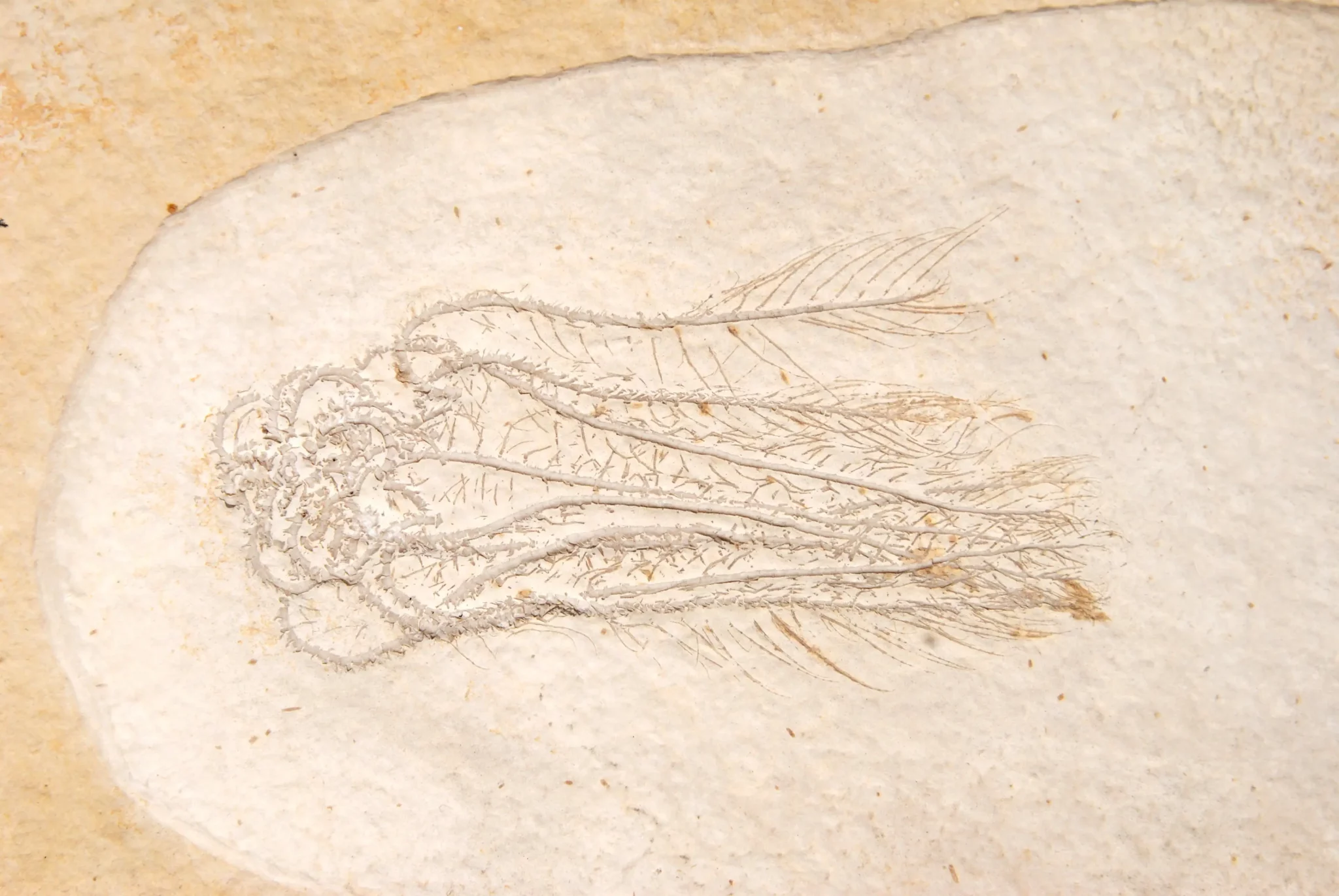
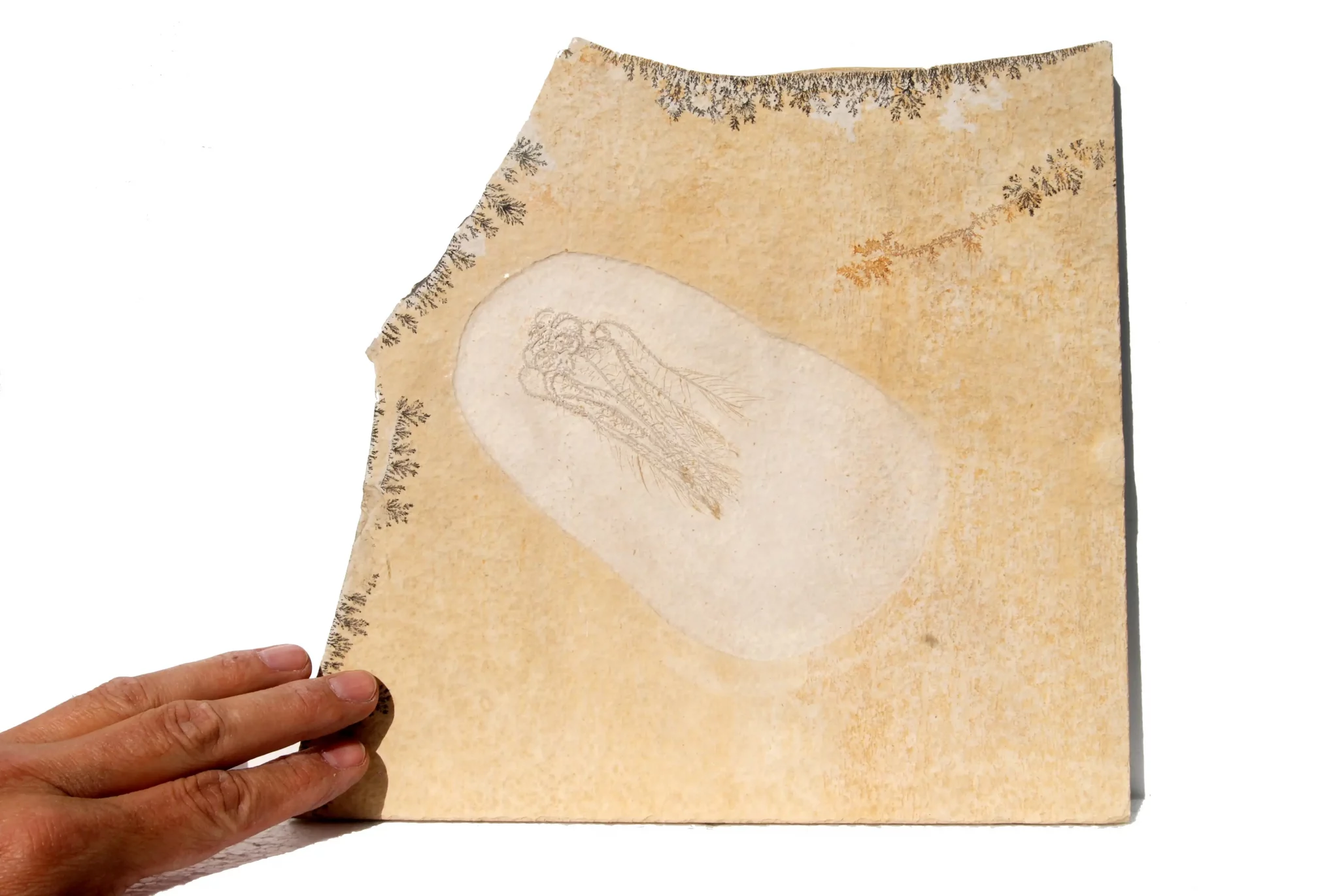
Solnhofen Comaturella pinnata
Place of discovery: Langenaltheim, Langenaltheimer Haardt; Solnhofener Revier/ Germany
Lithostratigraphy: Lower Tithonian, White Jurassic Group, Altmühltal Formation, Upper Solnhofen Subformation
Biostratigraphy: Hybonotum zone, rueppelianus subzone, rueppelianus horizon
Age: approx. 150.8 – 152 million years +/- 2 million years
Plate size: 26 x 25 cm
Size of fossil: 8.5 cm (largest size)
Perfectly preserved “Haarstern” – not colored.
Authentic fossil in original matrix, not reburied, unbroken slab. With proof of provenance.
Offered on behalf of the customer. Please do not make a payment in the store. Sale in the name and for the account of the owner. Contact: info@fossiland.com
Comaturella pinnata – The fossilized flower of the Jurassic Sea
Comaturella pinnata is not an animal in the classical sense, but a fascinating representative of the Crinoidea. While many of its relatives were firmly rooted to the seabed, Comaturella from the Upper Jurassic (approx. 150 million years ago) represents a highly specialized, free-swimming life form. In the fossil record, it looks like a delicate flower that has been captured in stone for eternity.
Scientific classification and morphology
- Dynamics of weightlessness: In contrast to stalked crinoids, hair stars such as Comaturella were able to swim actively or cling to corals or flotsam with their grasping arms (cirri). This mobility enabled them to survive in the nutrient-rich currents of the Solnhofen Archipelago.
- Fractal geometry: The body consists of a central calyx from which ten long, feather-like arms extend. These arms are covered with countless fine pinnules that form a huge surface to filter plankton from the water – a masterpiece of natural efficiency.
- Echinoderm anatomy: As echinoderms, Comaturella is related to starfish and sea urchins. Its skeleton consists of thousands of individual calcareous plates that were connected by elastic tissue, which gave it incredible flexibility in life.
The fine details – what collectors look out for:
- The preservation of the pinnulae: The absolutely critical quality feature is the visibility of the tiny pinnules on the arms. In simple pieces, often only the main arms (rami) are visible. However, if the fine “hairs” protrude from the arms like a delicate down, it is a specimen of the highest scientific and aesthetic quality.
- The crown of the arms: Pay attention to the completeness of the arms. An ideal collector’s item shows the arms in a natural, star-shaped spread-out position (“flower stage”), without the tips being broken off or hidden under the calyx.
- The calyx and the cir ri: Comaturella had clamp-like projections (cirri) on the underside of the calyx. If these are recognizable below the base of the arm, this gives the fossil a rare three-dimensionality and documents the anchoring method of the animal.
A highlight for every Solnhofen collection
Comaturella pinnata is the aesthetic highlight, a delicacy for echinoderm collectors. Its delicate structure is proof of the incredible preservation of detail in the Bavarian limestones.