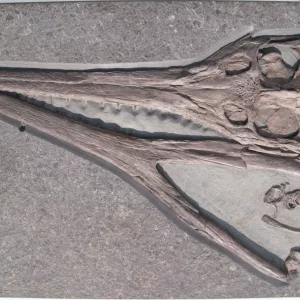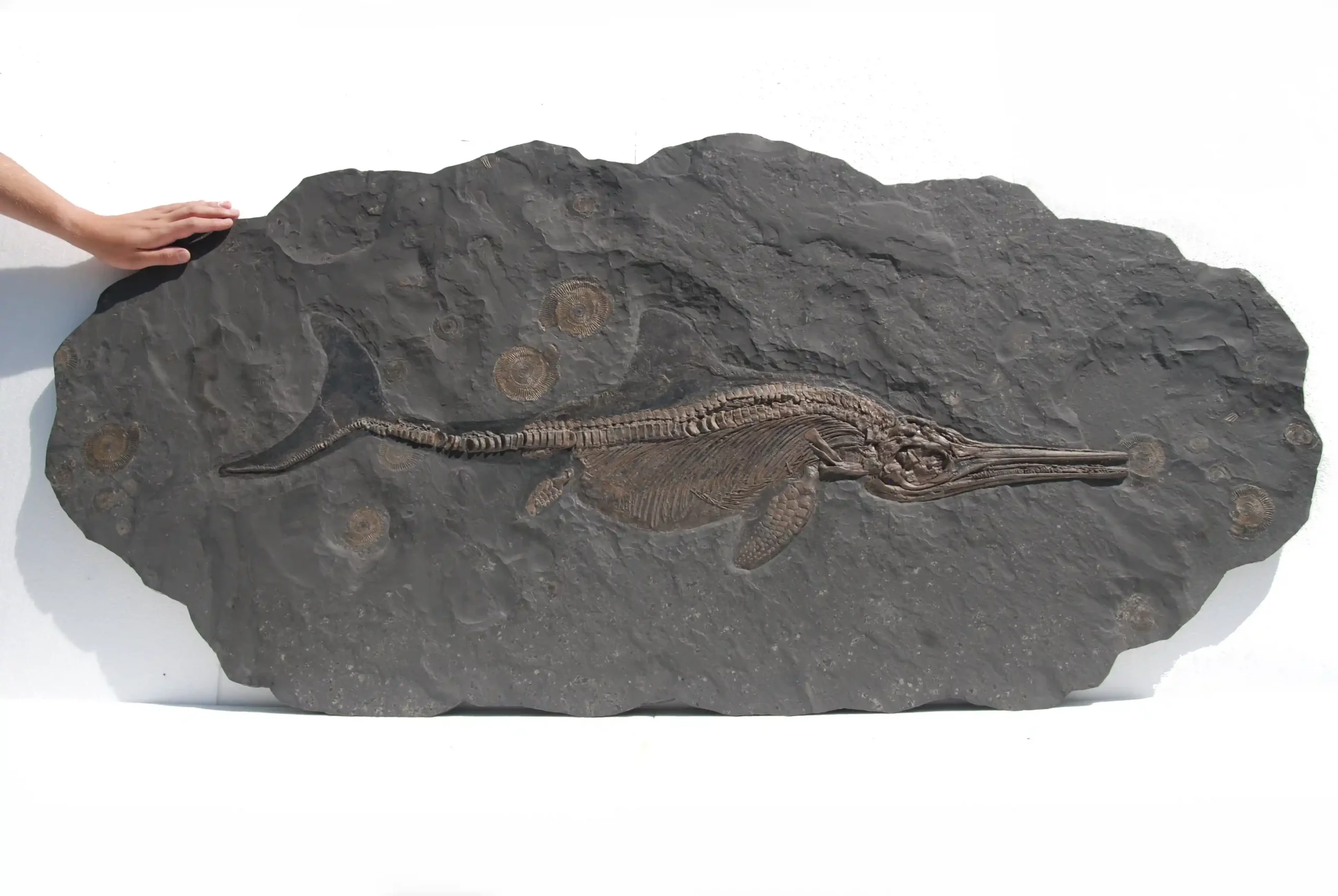
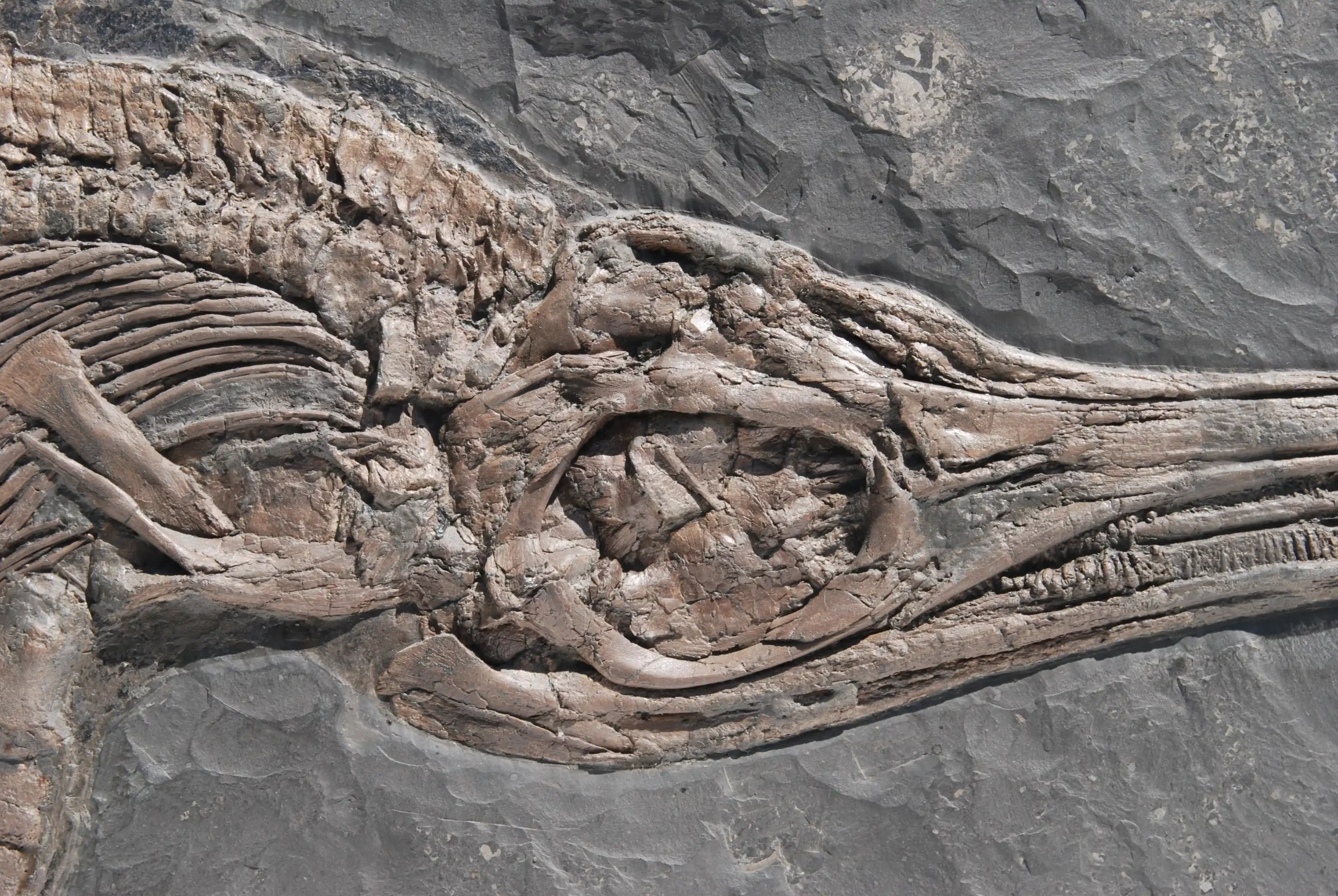
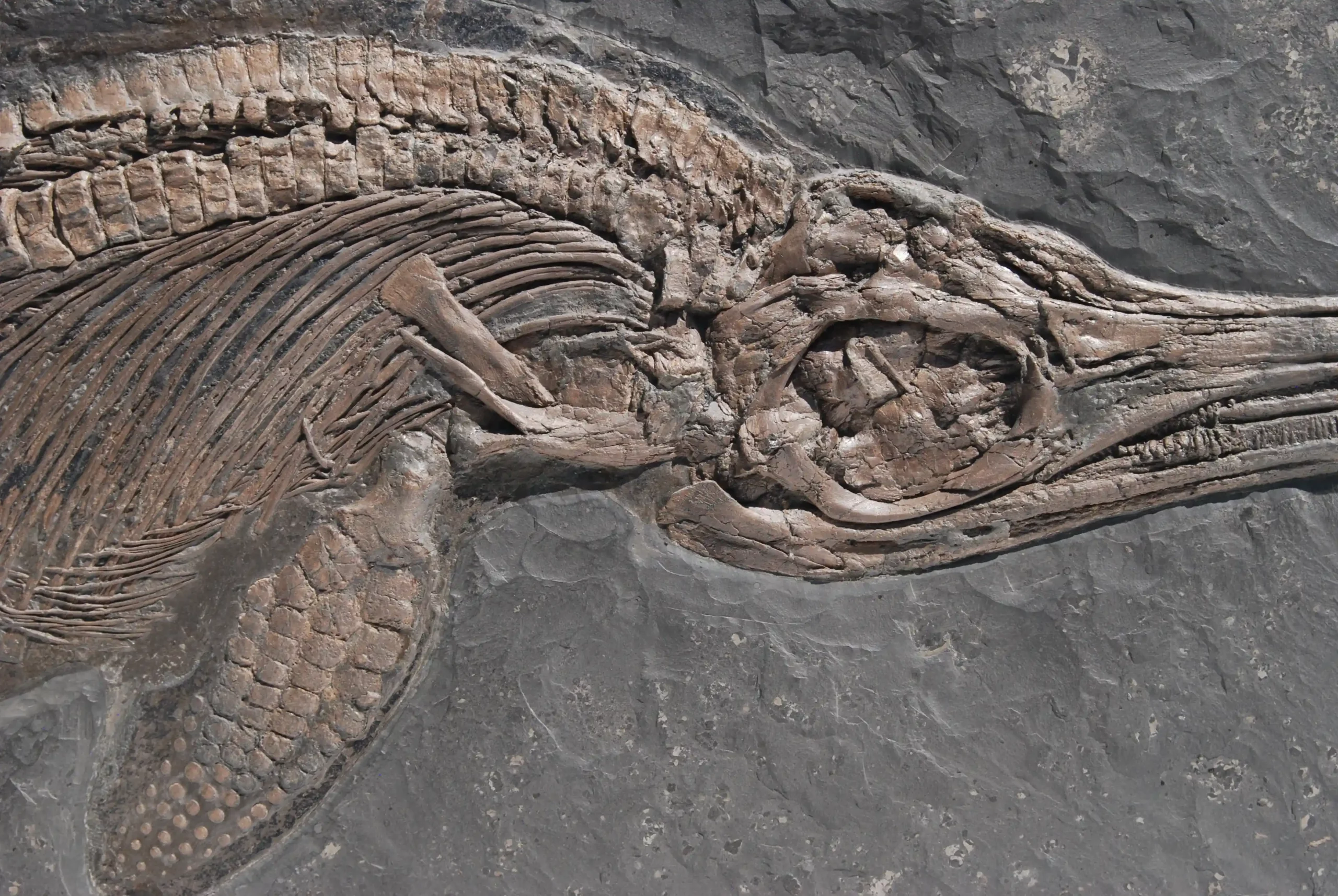
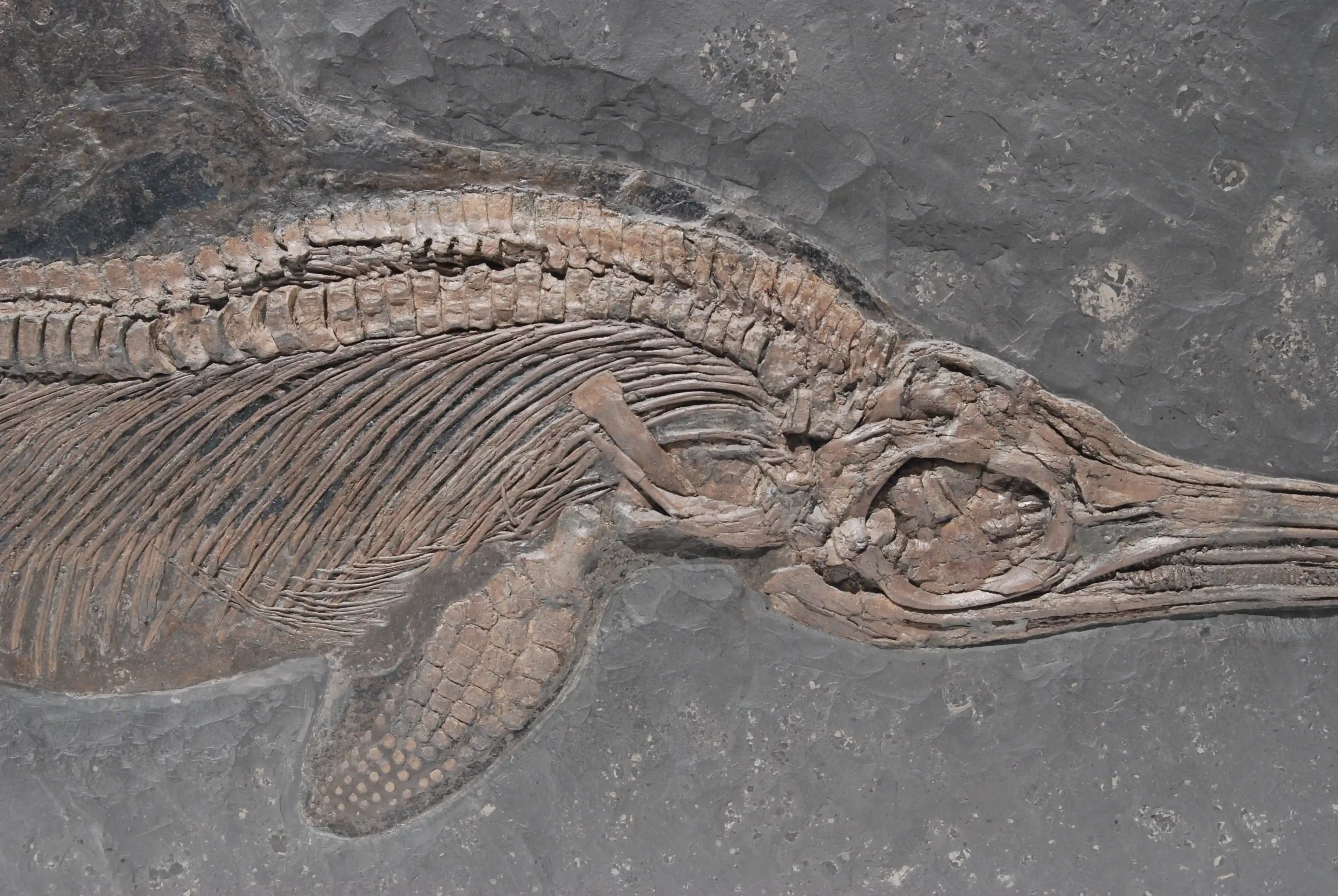
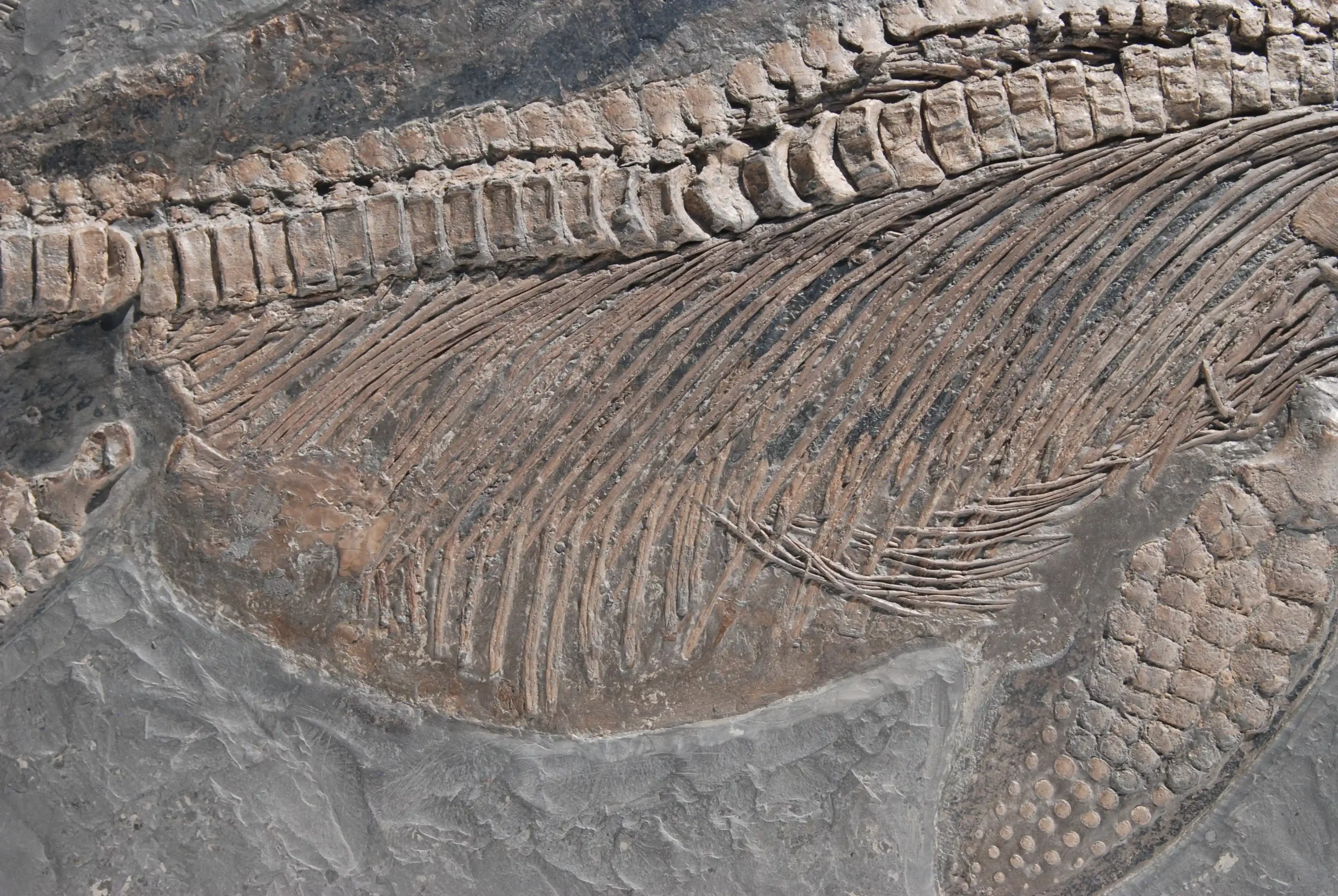
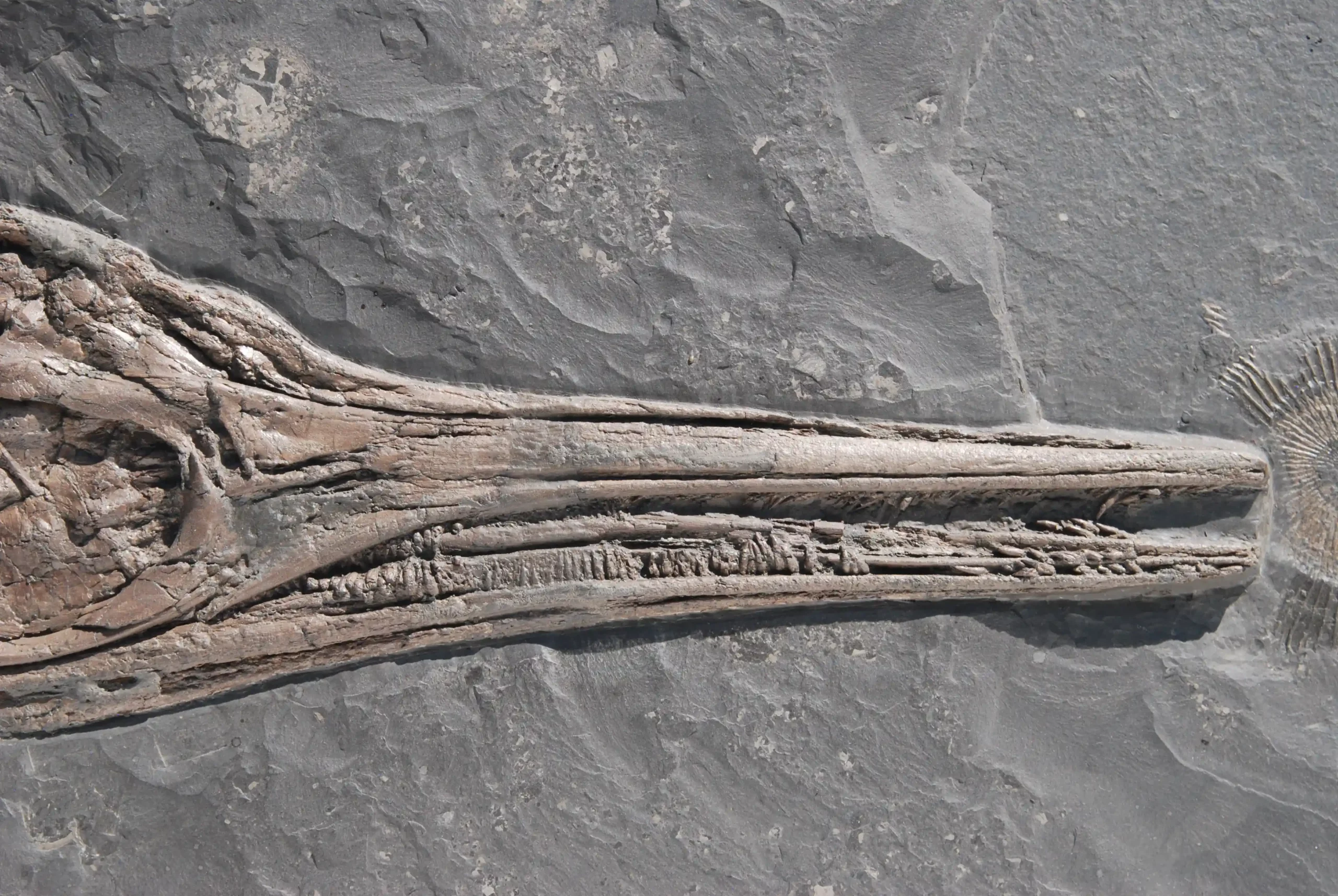
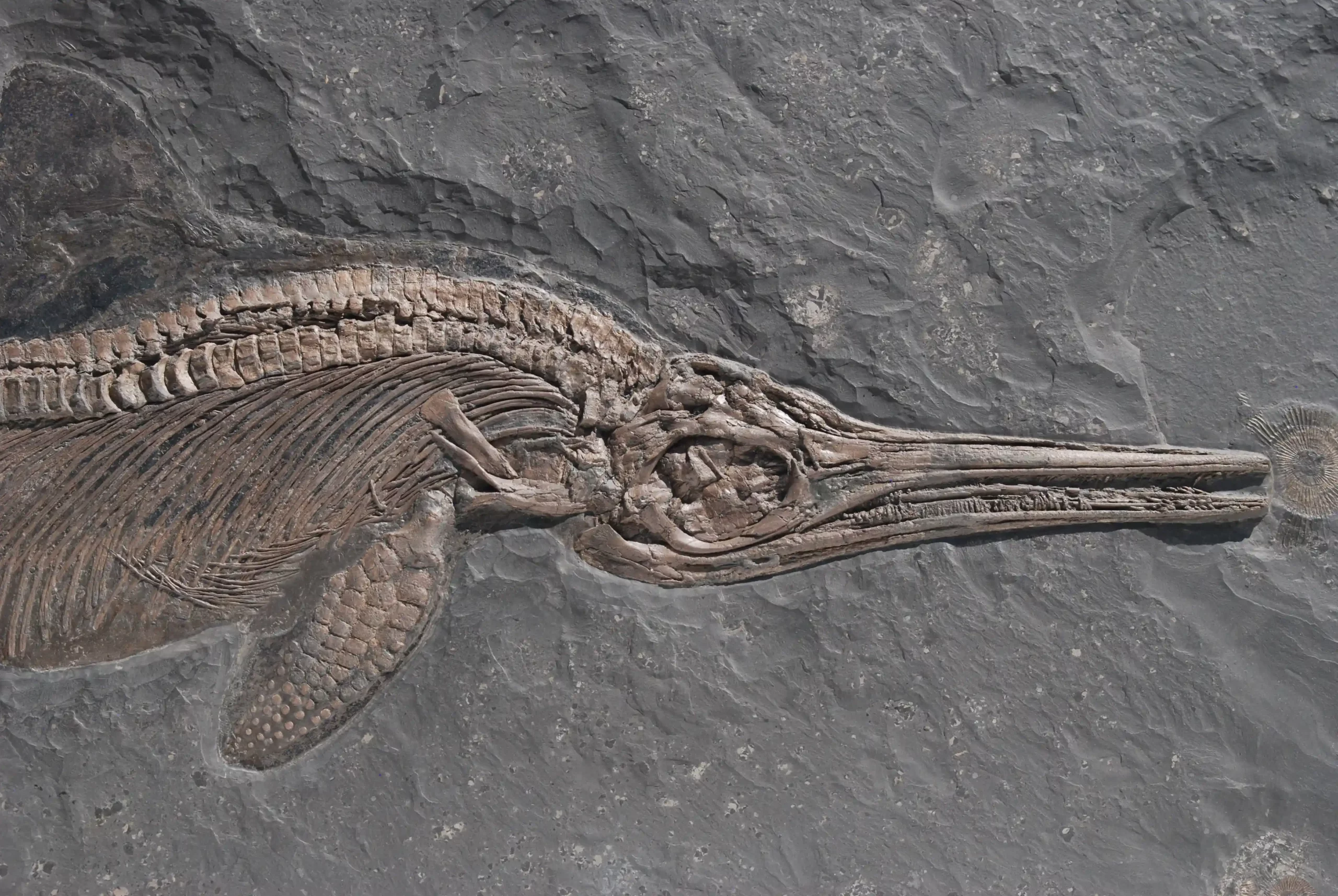
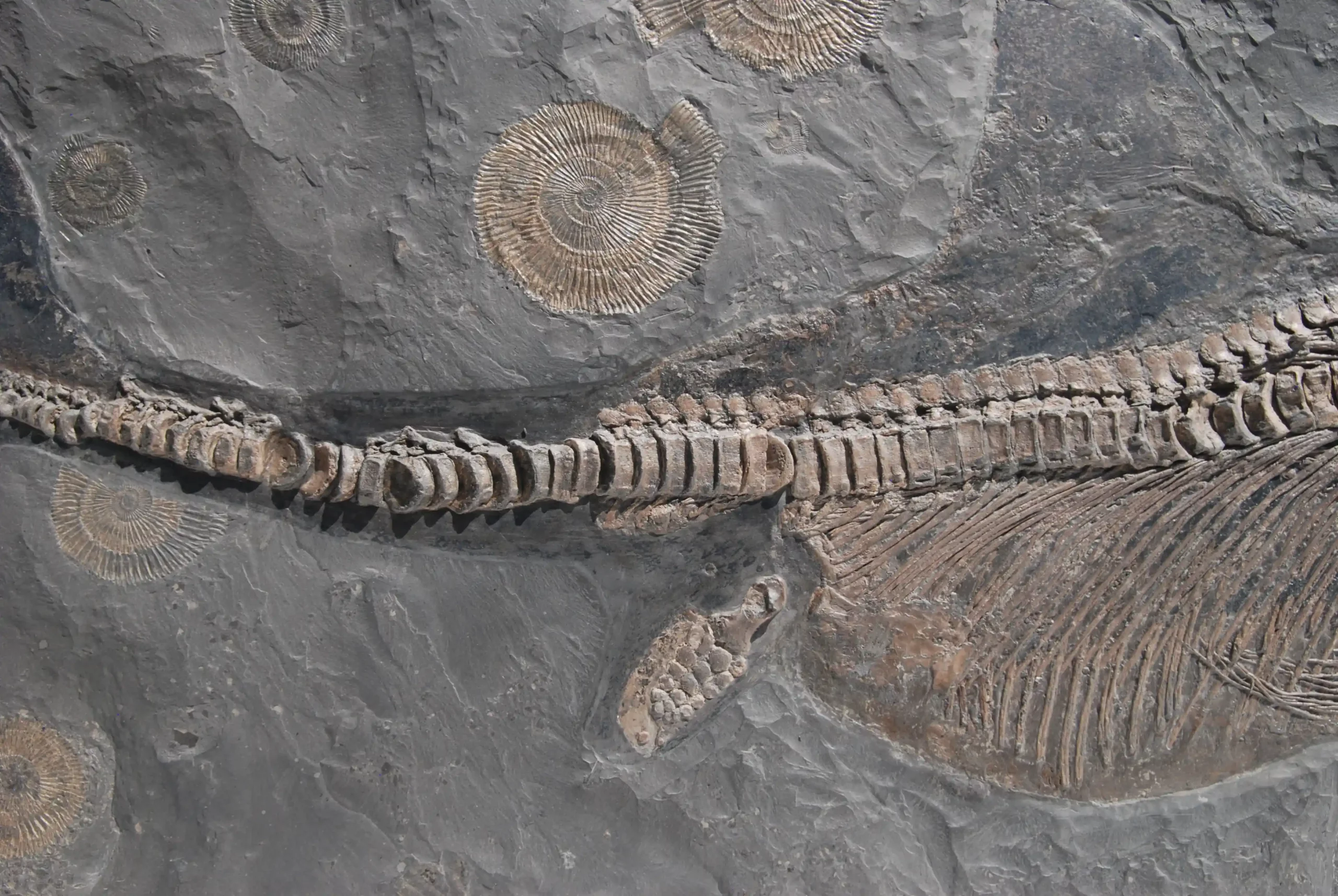
Ichthyosaur Stenopterygius quadriscissus
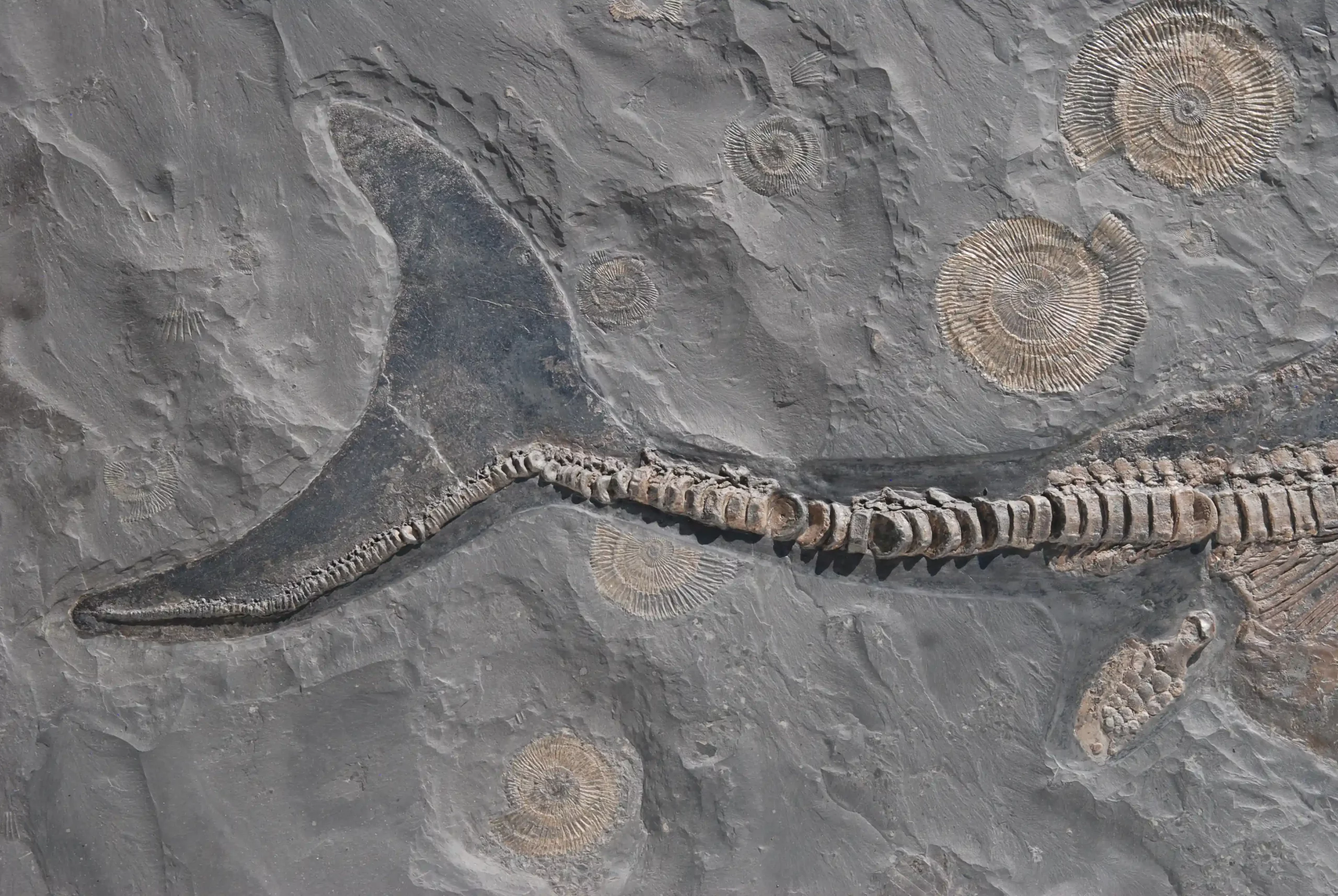
with partial skin preservation;
158×75 cm matrix, 110 cm fossil;
Lias epsilon; Holzmaden
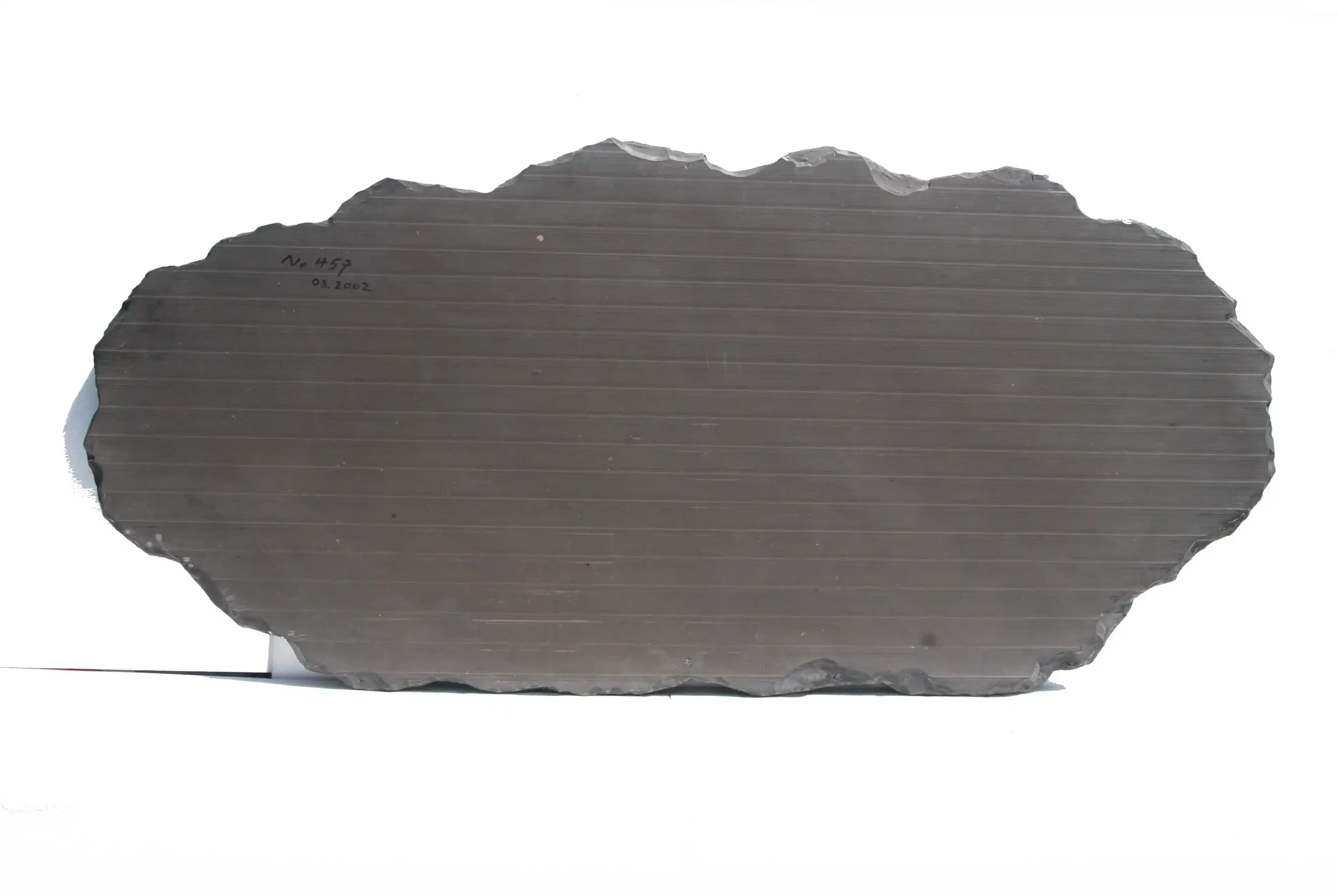
Complete juvenile with partial skin preservation, Hauff workshop no. 457 (03.2002).
When Bernhard Hauff, the legendary taxidermist, uncovered extremely fine, coal-black remains of an ichthyosaur in 1892 and was able to explain them as skin preservation, this was initially declared impossible by Prof. Oskar Fraas. In fact, it was the first time that remains of soft tissue had been uncovered on fossils. The triumphal march of the Holzmaden fossils into the world’s museums has been unbroken ever since.
The piece on offer is one of the few specimens that document this very special find. Typically recovered in several pieces, the fossil, a coherent individual, was inserted into a carrier plate in the workshop. To show the fossil to its best advantage, a silhouette was added and minor restorations were carried out to the usual extent.
The stable support plate on the back has been calibrated to a thickness of approx. 3 cm. A device for wall mounting is included in the scope of delivery.
A PREMIUM fossil from a famous taxidermy workshop, very decorative, stable in value.
Price on request.
The dolphin of prehistoric times: Stenopterygius quadriscissus from Holzmaden
It is considered the most iconic fossil of the world-famous Posidonia shale formation of Holzmaden (Lower Jurassic, around 180 million years ago). This species, whose name means “narrow-winged quadruple cutter”, dominated the Jurassic seas as a fast, fish-eating hunter. The fossils from this deposit are of inestimable scientific value due to their breathtaking preservation, which goes far beyond the skeleton.
Biology and lifestyle
The prime example of convergent evolution: it developed a body shape that looked strikingly similar to today’s dolphins or tuna (thunniform), even though it was a reptile. With a length of up to 3.5 meters, it was a medium-sized predator that used its streamlined shape and high, sickle-shaped tail fin to chase squid (belemnites) and fish at lightning speed.
Research suggests that the reptile was warm-blooded (homoiothermic) and had an insulating layer of fat (blubber), similar to modern marine mammals. This adaptation helped it to hunt in colder waters. Fossils also show that these animals were viviparous and gave birth to their young in the water.
The special feature of the soft divider posture
The real treasure of the Holzmaden finds lies in the exceptional preservation of soft parts that are not preserved in most other fossil deposits in the world.
- Skin outlines & pigmentation: Many specimens not only show the skeleton, but also a dark film that traces the outer body shape (fins, dorsal fin, caudal fin). Chemical analyses of these remains have even identified melanosomes (pigment cells) that indicate camouflage coloration: dark on the back, light on the belly (counter coloration).
- Connective tissue & blubber: Remains of a complex network of stiffened fibers were found in the fins, which gave the fins the necessary strength for efficient swimming. Chemical signatures of a layer of fat were detected directly under the skin, the first direct chemical evidence of warm-bloodedness in a fish dinosaur.
- Stomach contents & embryos: Rare finds show the last stomach contents (often hooks from belemnites) under the ribs or even fully preserved embryos in the womb, allowing conclusions to be drawn about diet and reproduction.
Holzmaden Conservation Site: A window into prehistoric times
This detailed preservation is due to the unique depositional environment in the Jurassic Sea: the extremely low-oxygen (anoxic) environment on the seabed. These conditions prevented scavengers and bacteria from decomposing the carcasses and enabled the formation of one of the most important fossil deposits in the world. A fish dinosaur from Holzmaden is therefore a fascinating scientific document that offers deep insights into the biology of a long-gone apex predator.