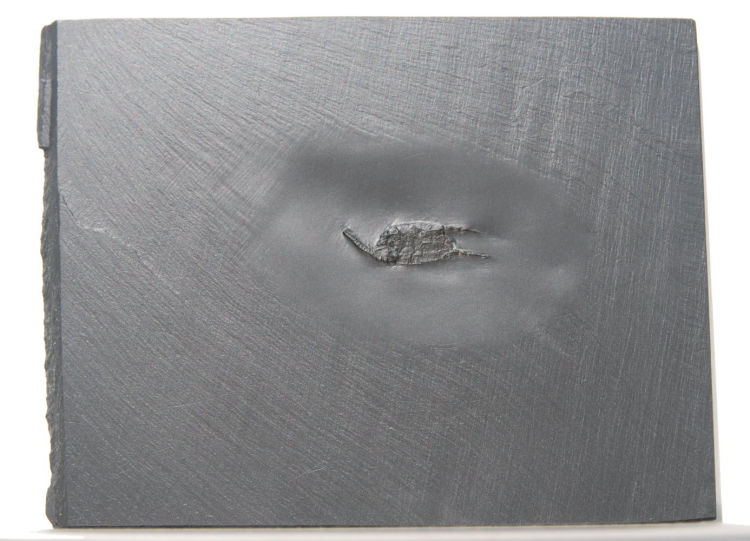
Bundenbach Rhenocystis latipedunculata
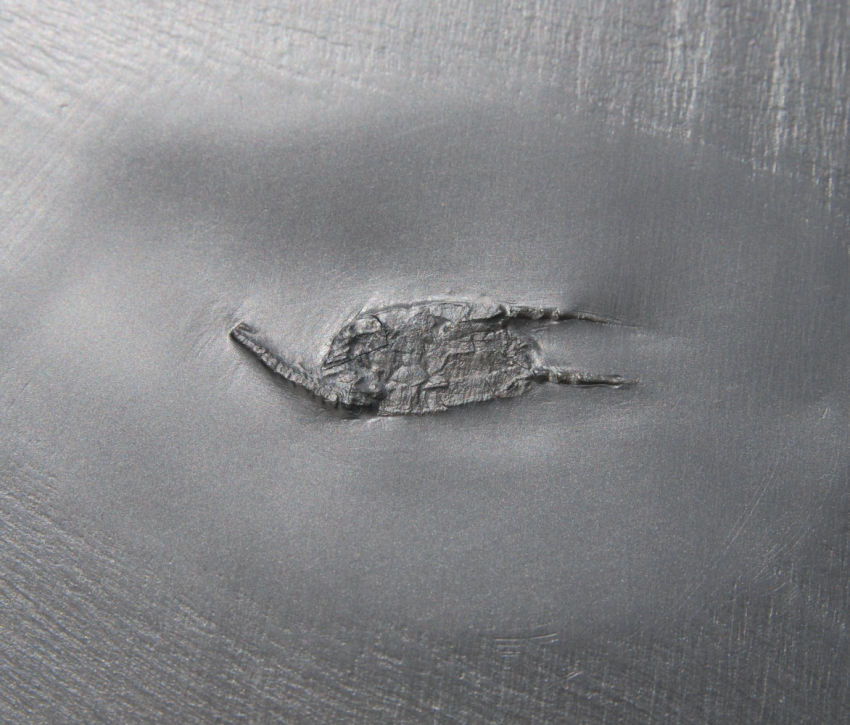
3.5 cm (fossil), 12.5×16 cm (matrix)
Bundenbach; Obereschenbach pit
Rare flat animal on unbroken plate with excellent details.
Rhenocystis latipedunculata – The armored oddball from Bundenbach
A break with symmetry: bizarre and defensive.
Anyone encountering this species for the first time will look in vain for the familiar five-rayed pattern of echinoderms. As a representative of the Homalozoa, it is an outsider in natural history – a creature which, with its spiny projection (aulacophore), is reminiscent of a crinoid, but which has taken a completely independent, asymmetrical path. An absolute must for any Hunsrück fossil collection that celebrates the curiosities of evolution.
The distinctive features – what makes Rhenocystis latipedunculata so special:
- The asymmetrical tank: The roughly rectangular theca (body) is a masterpiece of slab architecture. While the upper side consists of just two large central plates and eleven edge plates, the underside is a complex mosaic of 20 individual plates. This different armoring at the top and bottom is a fascinating detail for any systematist.
- The “twin spines”: The absolute trademark of this species are the two long, strong spines at the rear end of the theca. They give the fossil an aggressive, defensive look and make it instantly unmistakable on any slate.
- The dynamic stalk: The long aulacophore (stalk) is not just an appendage. It is spiky, tapers elegantly and is often preserved in the slate in an aesthetic curve. This curve gives the otherwise rigidly armored animal a wonderful dynamic.
- Geometry instead of blossom: Where crinoids impress with their filigree shapes, Rhenocystis impresses with its almost mechanical appearance. It is proof that the Devonian was a field of experimentation for the most bizarre body shapes.
A milestone from Bundenbach for science
The classification of Homalozoa (often referred to as “carpoids”) is one of the most exciting chapters in paleontology. Were they the ancestors of vertebrates or a completely separate dead end of nature? If you own a specimen like Rhenocystis, you not only have a fossil in your hands, but an active part of one of the biggest scientific debates in the history of the earth.