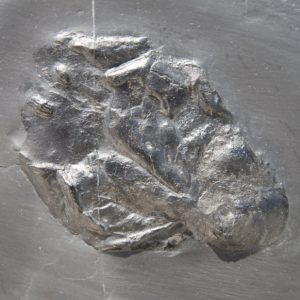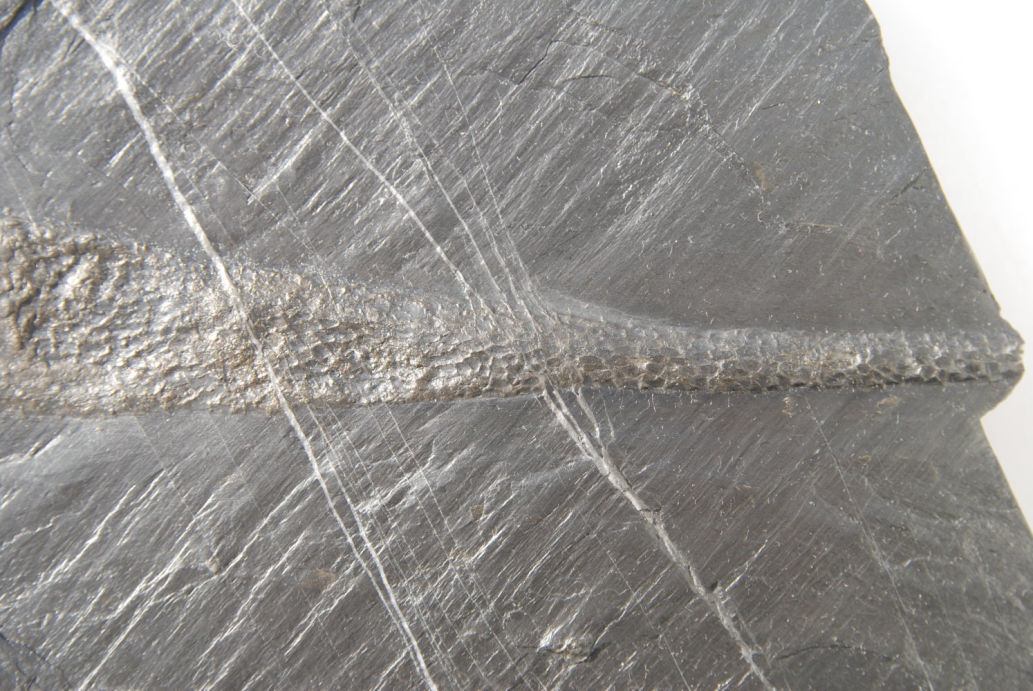
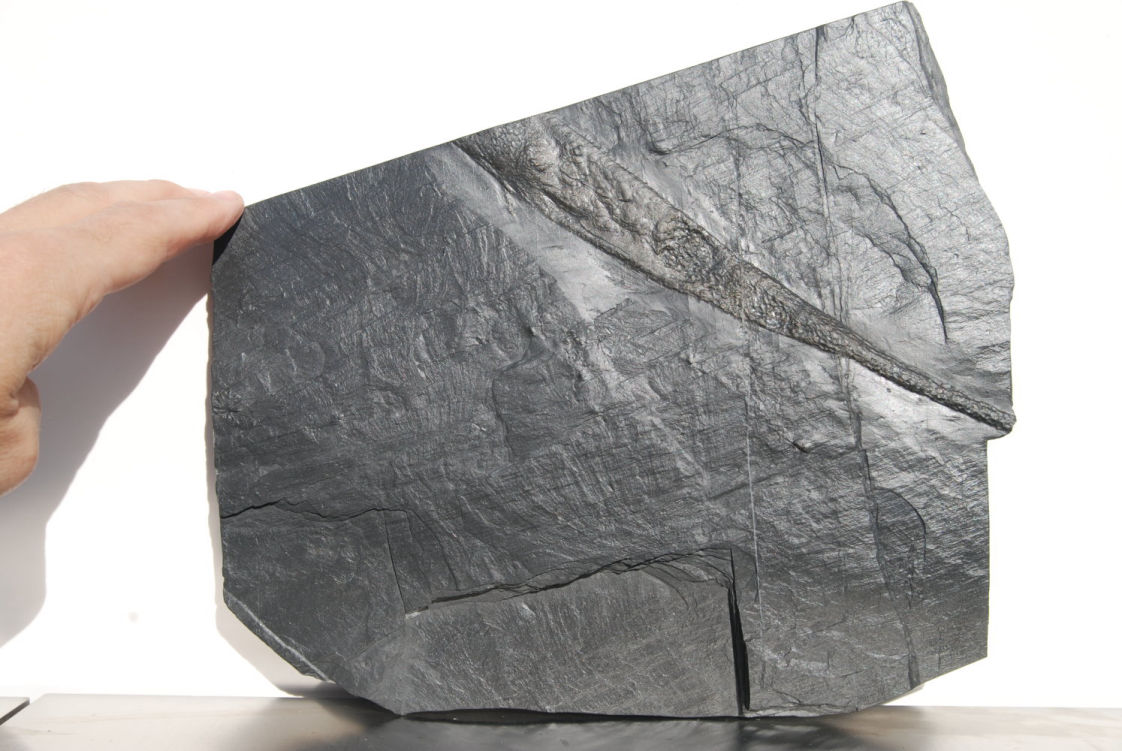
Bundenbach Orthoceras + Favosites
20 cm (fossil), 22×27 cm (matrix)
Bundenbach; Obereschenbach pit
Orthoceras with Favosites vegetation, on unbroken slab.
Sold
Orthoceras – The “arrow” of the Hunsrück slate
A cephalopod with streamlined aesthetics.
Long before the ammonites rolled their shells into spirals, orthocerates dominated the open water as “straight horns”. These early relatives of today’s squid were the undisputed hunters of the pelagic. An Orthoceras in the Hunsrück Shale is more than just a fossil – it is a symbol of speed and the early mastery of upwelling in the Devonian oceans.
The distinctive features of Orthoceras:
- The arrow-straight shape: The body (the orthocone) is elongated and tapers to a point. This aerodynamic shape allowed the animal to shoot through the water at lightning speed with recoil propulsion. On the slate, this line forms a spectacular graphic contrast to the branched shapes of the crinoids.
- The internal architecture (chambering): The interior of the housing is divided into numerous chambers by cross walls (septa). In many Bundenbach finds, these chambers are replaced by shiny golden pyrite or light-colored calcite, which makes the “skeleton” of the buoyancy system brilliantly visible.
- The siphonal canal: In the center of the septa, the sipho can often be seen – the “conduit” that the animal used to regulate the gas content in the chambers in order to float in the water like a submarine.
- Soft tissue sensations: The absolute highlight in the Hunsrück slate! In rare exceptional cases, shadows of the tentacle attachments or the ink sac are preserved in Orthoceras, making these pieces worldwide rarities of soft tissue preservation.
A world-class hunter from Bundenbach
Orthocerates were common worldwide, but their preservation in Rhenish slate gives them a special plasticity. While specimens from Morocco are often mass-produced, Bundenbach pieces impress with their fine, often metallic surface structure and their embedding in the deep black matrix.
Favosites – The golden honeycomb of the Hunsrück slate
Architecture of nature: corals with hexagonal symmetry
When talking about the structural power of the Devonian, there is no way around Favosites. This tabulate coral is a masterpiece of biological geometry. At a time when huge reefs dominated the tropical seas, Favosites was one of the most important builders. A piece of this coral in the Hunsrück slate is like a frozen glimpse into a highly organized colony from 400 million years ago.
The distinctive features of Favosites:
- The honeycomb structure: The characteristic that gives the honeycomb its name is the arrangement of the individual corallites. These are pressed so closely together that they take on a perfect hexagonal shape – exactly like the honeycombs in a beehive.
- The inner values (tabulae): In longitudinal section, the tubes show characteristic transverse floors (tabulae), which gave the group its name. This tiered structure gave the entire colony enormous mechanical stability against the surf.
- Pores for the community: With excellent preservation, tiny connecting pores (mural pores) can be seen in the walls of the calyces. The individual polyps were in contact via these channels – an early example of a networked superorganism system.
- High-contrast presence: In the dark Bundenbach slate, favosites often stands out in a wonderful three-dimensionality. As the cavities are often filled with calcite or pyrite, the “honeycomb” often shines golden or white on the black background.
A testimony to the reef giants from Bundenbach
Favosites is a symbol of the heyday of Devonian reefs. While most specimens occur as massive sticks, the finds in the Hunsrück slate are often particularly valuable, as they have preserved the fine microstructure of the walls and pores exceptionally well under the special preservation conditions of the slate.