
Fossil preparation creates decisive added value for sales
The scientific and commercial value of a fossil, as well as its aesthetics, are largely determined by the method used to uncover it.
30
Years of preparation experience
Fossil preparation
My fixed price offer
Tool
Hand tools, (compressed air) scrapers, etc. Gravers of various thicknesses of HW, fine blasting equipment with pure iron/calcium carbonate of various grain sizes
Aids
Surgical stereo microscope (Zeiss) with 50x resolution, UV lamps and much more.
Security
Closed system, blast cabinets with dental exhaust system and micro-fine filter.
From “praeparare” (Latin: to prepare) is derived the work step that determines the result.
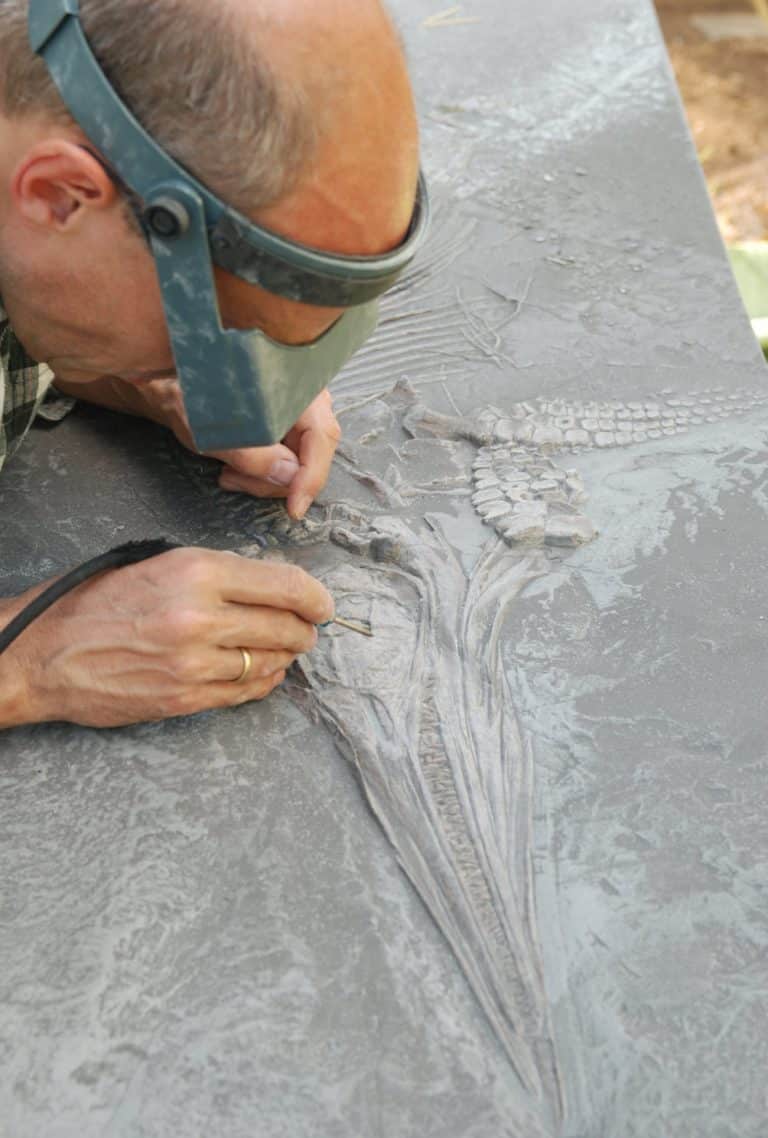
Fossil preparation has undergone a fundamental change in recent decades. Until the early 1980s, finds were prepared manually using gravers, scrapers and brushes, but since then instruments from dental laboratories have been introduced: Fine blasting and suction systems. Quality and aesthetics have improved considerably since then. On the other hand, there are pieces that are irrevocably lost due to their inadequate preparation.
Some fossils have not yet seen the light of day. Some collections are getting on in years and need a “refresh”.
The following is a look at workshops.


Preparation expertise
I gained my first fossil preparation experience as a research assistant at the Geological-Palaeontological Institute in Tübingen. There I prepared fossils from the Messel Pit. These came from a student excavation in 1988 under the direction of Prof. Frank Westphal, in which I took part as a volunteer. Our action was a protest against the planned backfilling as a “garbage dump” at the time. In 1995, the world-class fossil deposit was the first in Germany to be awarded UNESCO World Heritage status.
My preparation skills still meets scientific standards today, which is why it is in demand from museums such as the Natural History Museum in Mainz. Wouter Südkamp reports on an unusual and successful result in the Fossilien-Journal (2023-02). Below is an excerpt from the article:

Remarkable preparations of fish
The rump of these animals is often covered with a hard, black, pancake-like layer of rock, which largely prevents dissection. Despite phosphatization, the proportions of the fossil fish have been distorted. To my knowledge, no one has yet reported whether it has been tried or even succeeded in removing the concretionary phosphate substance. However, the Tübingen geologist and Bundenbach collector Christoph Leins achieved this first with a specimen of Drepanaspis (8A) and then with Gemuendina in a laborious process (pers. comm. Leins 2021).
The complete Drepanaspis was re-prepared in approx. 38 working hours, whereby the black coating was treated with potassium hydroxide (KOH).
The preparation result now revealed plate structures that were previously hidden by the black coating (8E).”

Examples
I have great expertise in fossils from Bundenbach and Holzmaden.
Holzmaden fossil preparation
Fossils from Holzmaden – reptiles, sea lilies and fish – are among my favorite objects. Fine blasting machines with different blasting materials are used here. You can find more examples of fossils preparation on my info page on Holzmaden fossils. I also specialize in the re-preparation of older specimens with potential as well as the restoration of specimens affected by the Pyritzerfall (“efflorescence”).

Bundenbach fossil preparation
Fossils from Bundenbach – crinoids, star animals, trilobites, fish, etc. – are my personal favorites. They captivate with their intricate details. My preparation tools of choice are fine scrapers, scalpels and needles. As the preparation is done under the binoculars, it is much more time-consuming than preparing fossils from other sites. You can find examples of my fossil preparation on my info page on Bundenbach fossils.

Cost of fossil preparation
If you are interested, please contact me and send non-binding photos by e-mail or WhatsApp.
If the fossil arouses my interest and I have the necessary capacities, you will receive a fee offer with a fixed price on this basis – without hidden costs. You can check this at your leisure. If you do not accept the offer, you will not incur any obligations.
The fee depends on the difficulty (location, matrix) and the resources required. An hourly rate of EUR 40 is calculated for Holzmaden fossils.
Partners
I cooperate closely with scientific institutions. I work as a taxidermist and restorer for numerous museums, including the natural history museums in Mainz and Göppingen.


Quality promise
As a member of the Association of Applied Paleontology (AAPS), Fossiland is subject to strict rules of conduct for the responsible handling of fossils. I assure you of serious handling and fair business practices for my Fossil appraisals.

Customer testimonials on fossil preparation
Gepostet auf Google Yuxi Wang
Trustindex überprüft, ob die Originalquelle der Bewertung Google ist.
Wonderful solnhofen specimen with secured delivery service. I’ve been dealing with the seller for many years. He is always reliable on fossils quality and rareness !!!Gepostet auf GoogleDaniel DantsigerIch habe bei Fossiland vergangene Woche ein Fossil aus Holzmaden schätzen lassen. Man merkt, dass man hier von einem Spezialist beraten wird.Gepostet auf GoogleLeon MaierSeriöser Shop für Fossilien aus Holzmaden, Solnhofen, Messel und BundenbachGepostet auf GoogleThomas SchultzIch habe einen wunderschönen Ichthyosaurier bei Herrn Christoph Leins von Fossiland gekauft. Die Kontaktaufnahme, Abwicklung, Besichtigung und Abholung haben zu meiner größten Zufriedenheit funktioniert. Ich kann Fossiland nur als sehr gute Adresse für einen Kauf empfehlen. Einfach nur Top. Danke Chris!Gepostet auf GoogleZüleyha ErdemLief alles bestens. Ich kann Herrn Leins nur weiterempfehlen.Gepostet auf GoogleViki Stgttecht krass, kennt die Urzeitviehcher alle mit Namen. Danke und weiter so 👍Gepostet auf GoogleFamilie Yscheint „Platzhirsch“ zu sein in Sachen Bewertung von Fossilien aus Holzmaden. Gute Reaktionszeit.Gepostet auf GoogleJeremy RetzloffUnkomplizierte Abwicklung, netter Kontakt, gerne wieder!Gepostet auf GoogleStefan KotschSehr gute und schnelle Beratung durch Herrn Leins per Email bezüglich Fossilien und deren Preisfindung. Sehr empfehlenswert.