Fossil forgeries or “fake fossils” are when a fossil or parts of it are not original, but the seller does not disclose this fact – either out of ignorance or deliberately. Many sellers have no knowledge of preparation and are sometimes only partially able to distinguish between original and restoration. To make matters worse, very few fossils are sold directly from the preparation workshop. Knowledge of any fakes is therefore “lost” from hand to hand.
40
Years of market knowledge
Proven for many years
Expertise
As a geologist/paleontologist and taxidermist, I know how to distinguish between an original and a replica.
Seller and buyer protection
As an expert, I am liable for my appraisals, condition reports (when consigned at auction) or other descriptions of the condition of your fossil.
Added value
An authenticity check not only provides security, but also increases the sales proceeds.
What types of fossil fakes are there?
Greed for a “quick buck” is the mother of invention, especially in circles far removed from palaeontology. As a result, there are art forms of varying degrees of sophistication. Basically, the higher the quality of the fossil, the greater the temptation to “recreate” it.
Often these are not complete fossils, but partial restorations. The missing tail on fish, the missing tip of the snout on reptiles, etc. are often added. Restorations of the fossil to an extent of >5% are problematic if they are not identified as such. This does not include clean bonding of fractures.
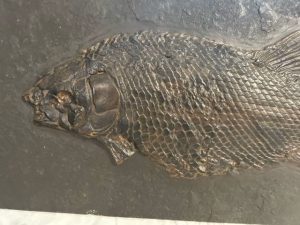
Carving
“Well made”, such carvings are sometimes only recognizable at second glance. Correct initial finding: original rock. The example shown lacks the typical bone structure and shine of the ganoid scales.
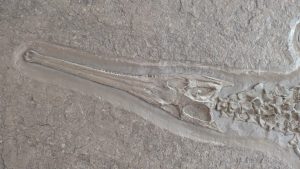
Cast
Another refinement is to insert replicas, hand-colored, into an original matrix (slate). Initial finding: Surrounding original rock. The example shown was purchased for a five-figure sum.
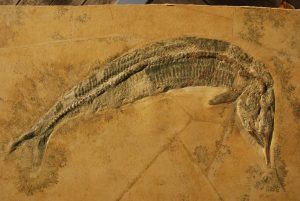
Application
The effort can be further reduced if true-to-original color prints of a fossil, whether on plastic or artificial cardboard, are glued onto the original matrix (in the example Solnhofen slab limestone). At least the back is original.
Many other examples, sold for five figures on the Catawiki platform, I had already shown elsewhere, but was confronted with a warning from the dealer concerned, which is why I have to refrain from doing so.
How do you recognize fossil fakes?
A trained eye can recognize fakes or reconstructions in most cases. However, it must be acknowledged that the tricks of the trade are becoming increasingly sophisticated. For example, adhesives that fluoresce under UV light are no longer used.
Anatomy
The easiest to recognize are anatomical anomalies, such as bones “carved” out of the stone. Bone and matrix show – quite untypically – no color contrast.
UV light
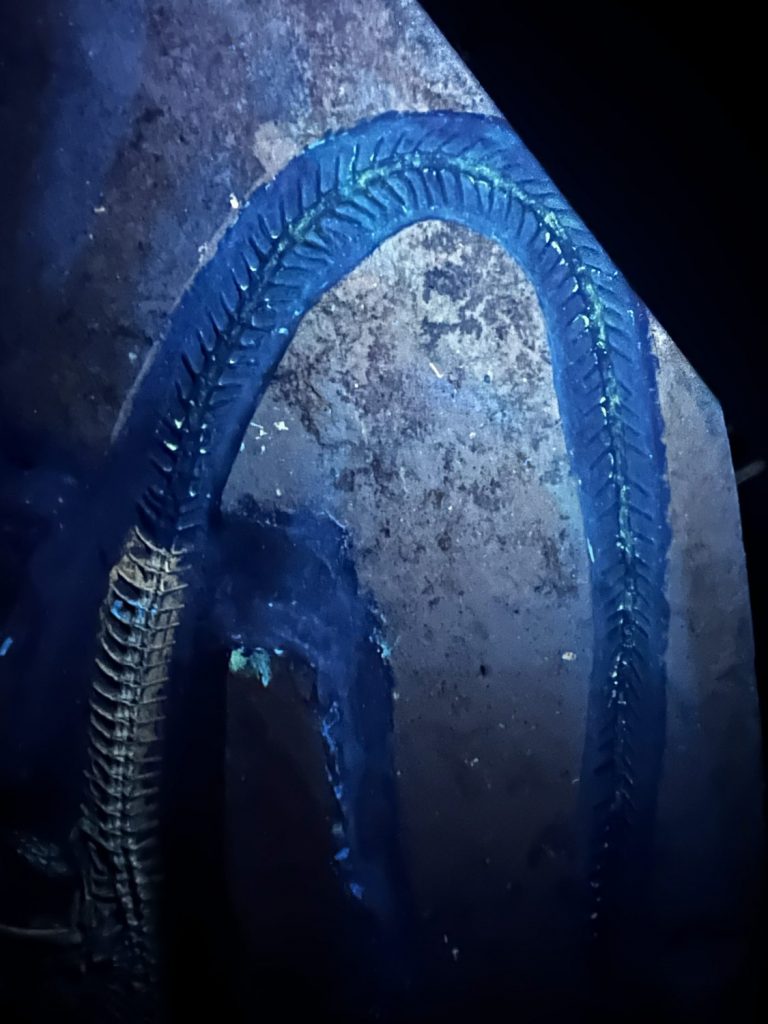
Restorations are not uncommon in fish (the rule in Lepidotus) and are not “fakes”. They are easily recognizable under UV light, but can also be seen with the naked eye.
Air bubbles
Air pockets reveal the use of epoxy resin. They could not escape during curing. Nowadays, “improved” materials such as ApoxiSculpt are used.
X-ray images
Self-commissioned X-ray images can also be helpful. However, you should be aware that forgeries from China are now circulating with equally forged images.
Head loupe and scalpel
My favorite tools for checking for possible fossil forgeries are a head loupe and a scalpel.
Further information on fossil forgeries
Fake fossils have a long tradition.
Würzburg lying stones
As early as the 18th century, the Würzburg Lying Stones shook science: Johann Beringer was taken in by fake fossils foisted on him by envious people. These historical forgeries show that the greed for sensationalism often clouds our vision.
Holzmaden forgeries
Further information can also be found on my information page on wood maggot fossils.
Vigilance is still required today, as manipulated finds are flooding the market. Authentic collector’s items from selected sites (Holzmaden, Bundenbach, Solnhofen, Messel) can be found in the store.
Please feel free to contact me if you have any questions on the subject of fossil forgeries or “fakes”.