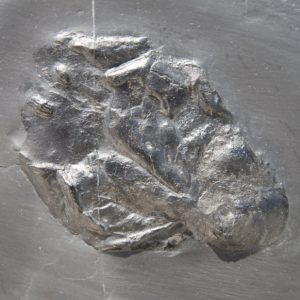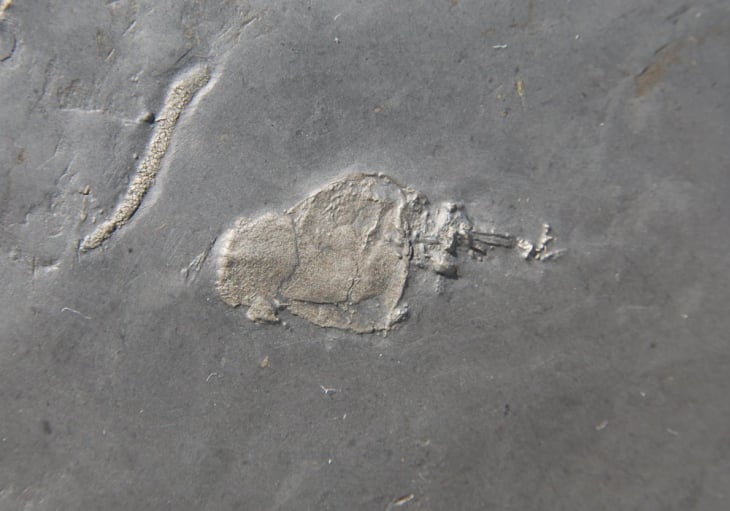
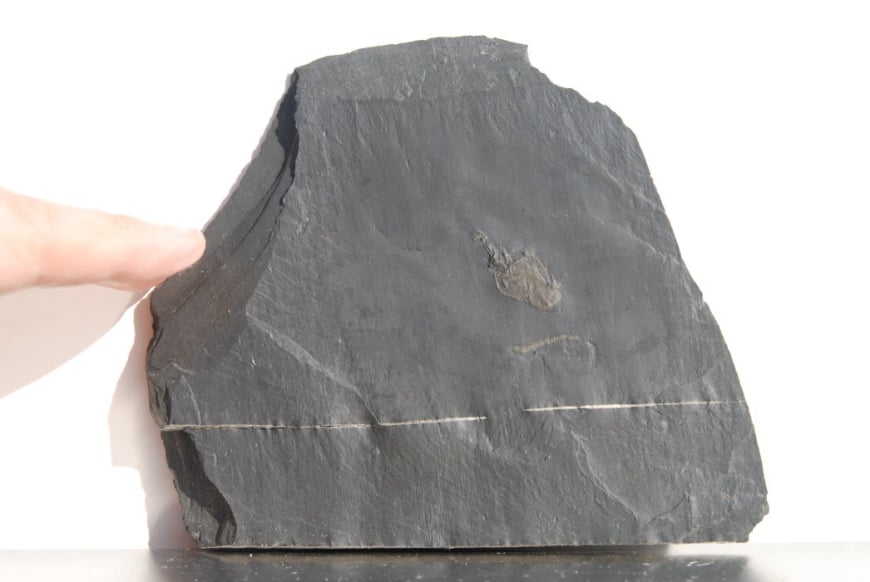
Bundenbach Anatifopsis styloidea
2.5 cm (fossil), 12.5×15 cm (matrix)
Bundenbach; Obereschenbach pit
Very rare, primitive representative of the Homalozoa, on unbroken plate with excellent details.
Anatifopsis styloidea – The enigmatic “UFO” of the Devonian Sea
A rarity: bizarre, rare and a top-class puzzle of evolution.
Forget everything you know about classical symmetry. Anatifopsis styloidea (still known to many collectors as Mitrocystites ) is one of the great unknowns of prehistoric times. It is significantly rarer than the better-known Rhenocystis and an absolute must for collectors looking for the unusual and scientifically exciting.
The distinctive features – how to recognize Anatifopsis styloidea::
- The semi-circular geometry: The body of this exotic vehicle impresses with its striking, roughly semi-circular shape. It almost looks like an armored vehicle from prehistoric times. The anatomy is highly efficient: the underside consists of two large plates that elegantly overlap on the upper side – a design that offered protection and stability in the mud of the seabed.
- Fine ornamentation: if you look closely, you will be rewarded. Fine, pearl-like nodules can be found along the edges of the upper surface. This subtle structure gives the fossil a wonderful texture and clearly sets it apart from plain specimens.
- The sturdy stem: The stem of Anatifopsis is a real character piece. It tapers towards the bottom and – in contrast to the rest of the body – is conspicuously spiny. This combination of smooth body and spiny appendage makes the fossil a dynamic eye-catcher.
- The fine differentiation: In direct comparison to Rhenocystis, Anatifopsis appears more subtle. While Rhenocystis is often characterized by a dominant, strong spine, Anatifopsis scores with its flat elegance and fine nodule decoration.
A highlight for evolution specialists
Anatifopsis belongs to a group whose way of life is still the subject of debate among paleontologists. Was it an early ancestor of vertebrates or a highly specialized echinoderm? Anyone who owns a specimen of this species will have a piece of unsolved geological history in their display case.